A feast of nature? Or cooking with leftovers.
Few topics ignite fierce debate quite like private land ownership and public access to wild places.

The people of NSW have a few months to choose their next Government. But they have just a few days to speak up on a topic set to dominate election debates: our National Parks.
The National Parks Establishment Plan 2026 (NPEP) guides the expansion of the state’s protected areas and closes for public feedback at 11:59pm on Monday, October 12.
- National Parks Association CEO Gary Dunnett has called for Marine Parks and Aquatic Reserves to shift from Fisheries control to the Environment department, saying “No one would expect koala hunting in a National Park, yet hunting iconic wildlife is commonplace in Marine Parks.”
- National Parks Association (NPA) leaders also urged the NSW Government to think bigger and act faster to expand National Parks while dispelling widespread myths about how conservation land is acquired and what activities are allowed in National Parks.
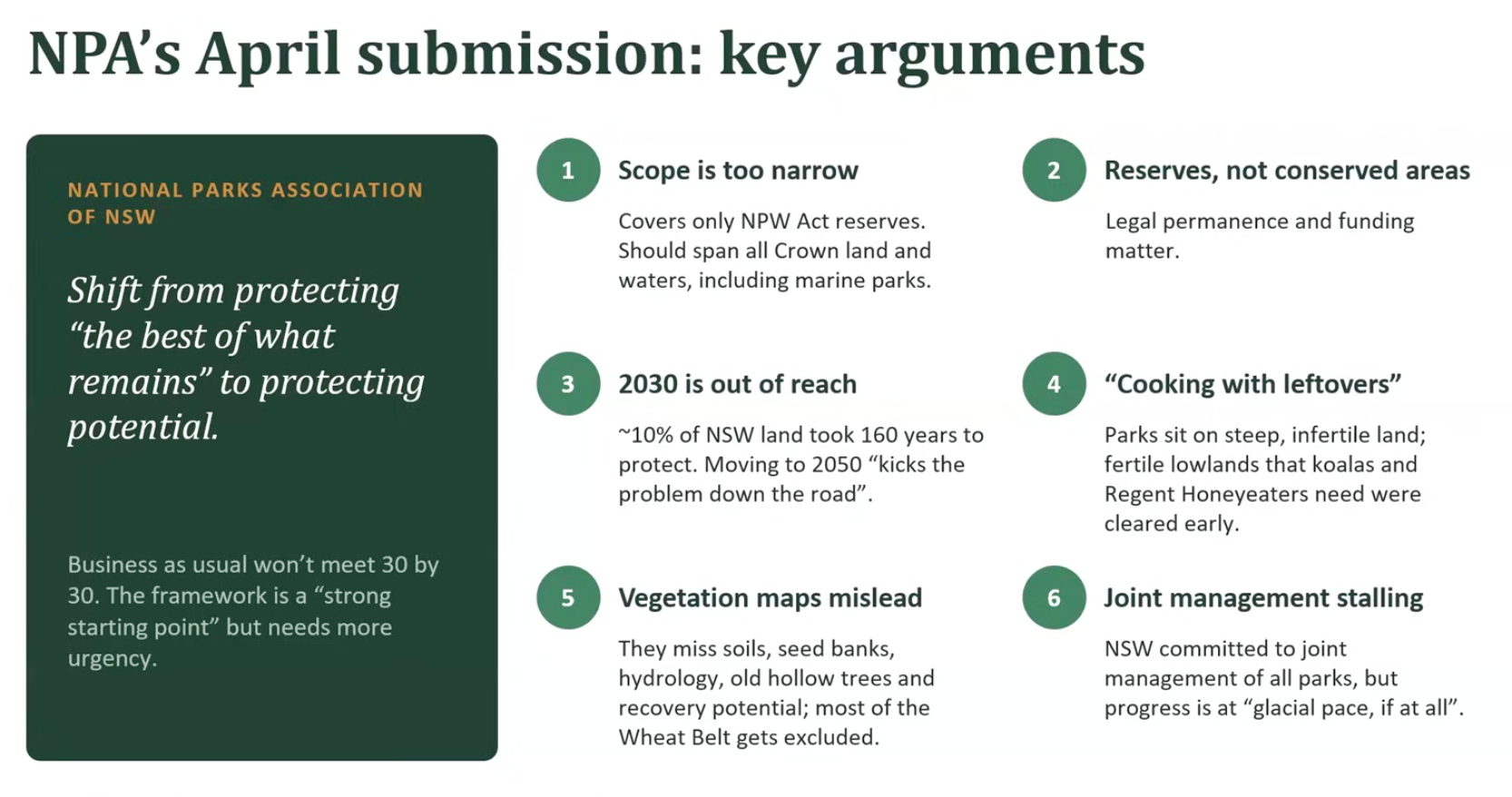
- NPA convenors Ross McDonnell and Warwick Pearse called National Parks strategy "cooking with leftovers", because Australia’s nature reserve system was created from whatever survived two centuries of clearing for agriculture or forestry.
- The NPEP estimated that damaged land costs seven times as much to restore and manage as healthy habitat.
- The Shooters Fishers & Farmers MP Mark Banasiak said the NPEP "sounds like a wedding but is more of a funeral for the sawmill". "The gate goes up, the mills shut and the weeds move in."
Reimagining NSW National Parks with urgency, ambition and practical strategies.
Few topics ignite fierce debate quite like private land ownership and public access to wild places.
Conservationists seek bold habitat protections for climate and biodiversity resilience. Nature tourism offers an antidote to extraction. Hunters fear being excluded from their veritable backyard. And forestry workers oppose losing earnings from native timber extraction.
Whether a dispute is over saving koalas, killing brumbies, storing carbon, buying farms, conserving species, protecting heritage, fighting bushfires, ending native logging or generating regional jobs, it’s all part of the huge and complex National Parks story.
Some love National Parks and want more. Some hate restrictions and demand no more. Most take them for granted as synonymous with Australian culture, environment, recreation and the economy.
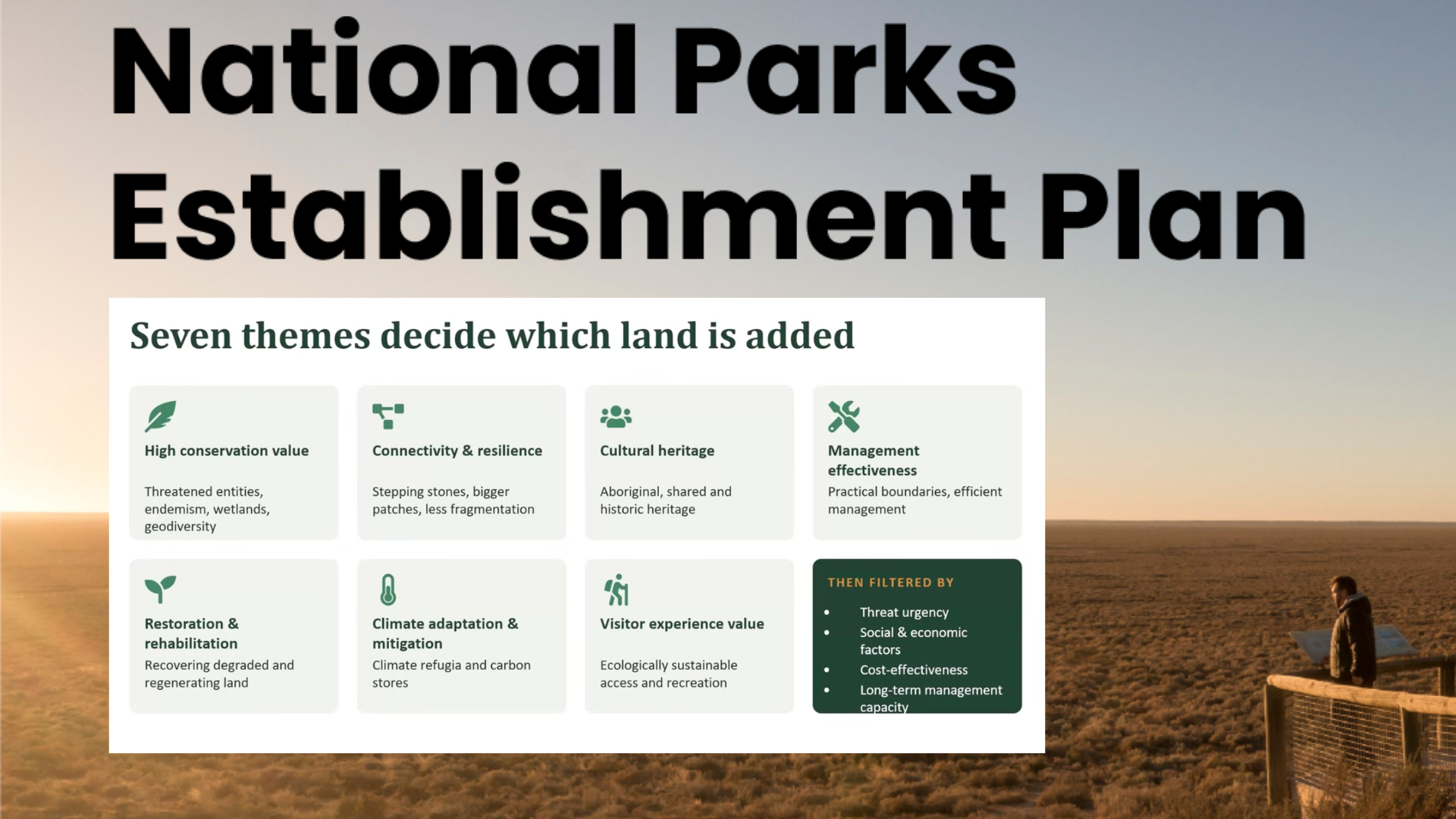
An important Government document, the National Parks Establishment Plan 2026 (NPEP), was quietly published last month as a blueprint for how and why more land (and water) can be protected in future NSW National Parks.
Two opposing organisations have strained to lift the issue higher into view, urging the public to submit feedback either via the survey or in more detail.
The NSW National Parks Association (NPA) is a non-governmental charity of bushwalkers, scientists and conservationists that have, since 1957, researched, mapped, and lobbied to create the state's most famous protected landscapes, especially National Parks.
The Shooters, Fishers and Farmers Party (SFFP) is a conservative Australian political body formed in 1992 to advocate for regional and rural communities, particularly on firearms ownership, property rights and recreational outdoor access.
The SFFP's position is simple: “No New National Parks”.
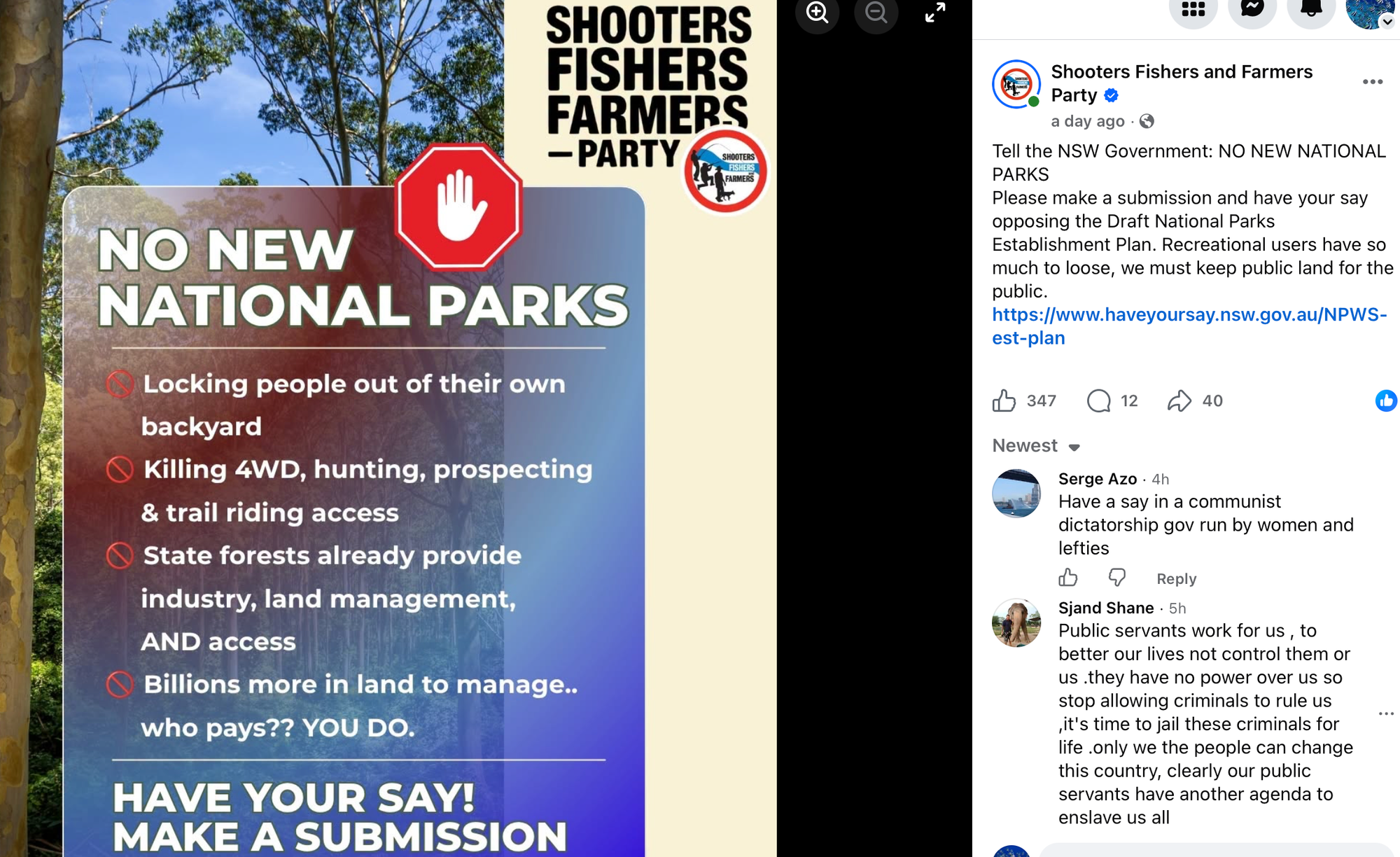
Mark Banasiak, the party’s representative in the NSW upper house and Chair of the Federation of Hunting Clubs, claims that by disallowing hunting, 4WDing and forestry operations, National Park land will be unmanaged and more vulnerable.
Banasiak mocks the goal of ecological 'connectivity', and his party’s policy states that “inner-city activists” and bureaucrats are “preaching conservation” and “allowing weeds to spread, fire risks to build, feral animals to explode, and public infrastructure to collapse through neglect.”
“We reject the radical “lock it up” ideology that treats human activity as a threat and public land as a museum,” Banasiak said.
The NPA shares that crucial concern over on-the-ground management and it opposes "paper parks"—reserves declared, but without field staff, rangers, or funds to care for the place.
But NPA’s position on the parks vision is more detailed and considers landscape-scale ecology and economics over the rights or expectations of individuals.
Rare pink lakes will draw visitors to the NSW outback
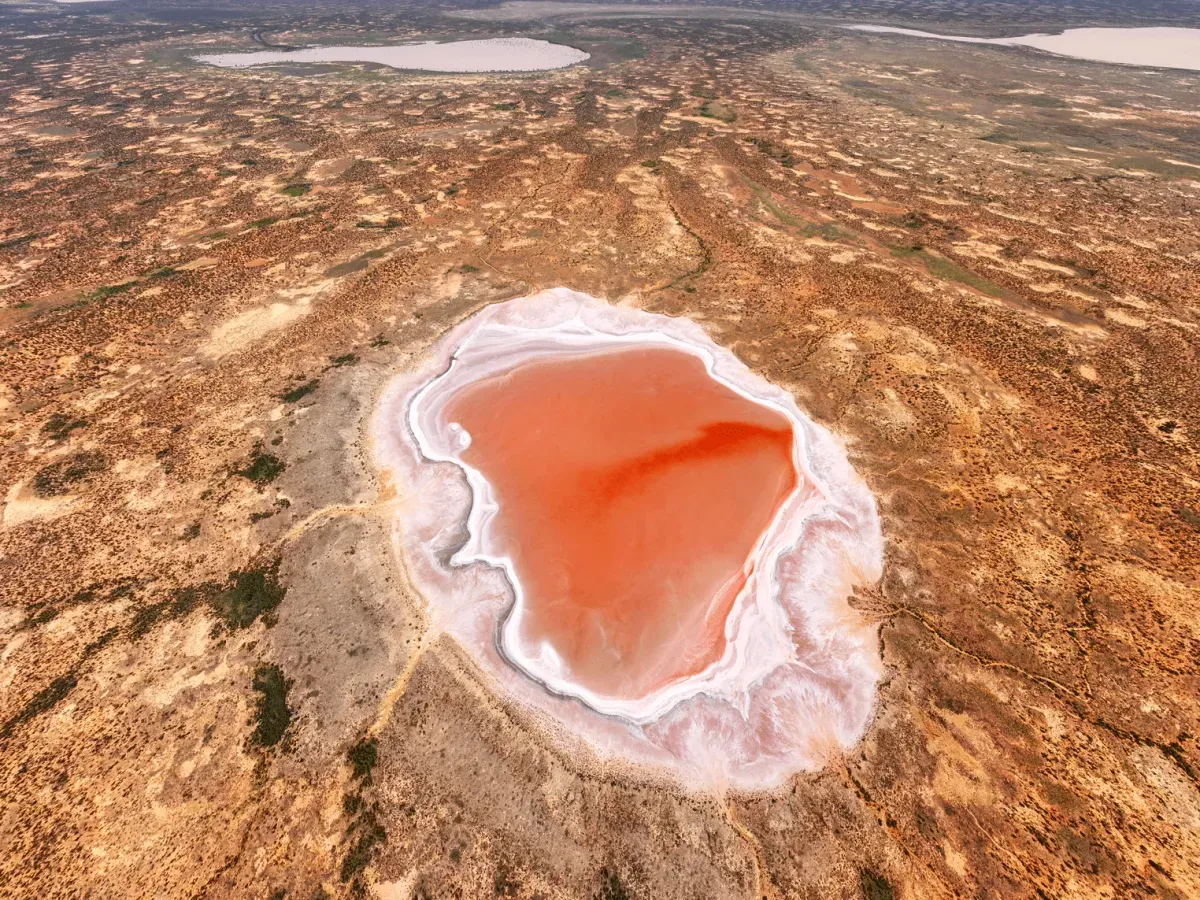
NSW's first protected pink lakes will soon open to campers and visitors as a NSW National Park, following state and federal governments' acquisition of Pulgamurtie Station.
The joint purchase will safeguard more than 74,000 hectares of outback landscapes and ecosystems in Far West NSW, around three hours’ north-east of Broken Hill, including two striking pink saltwater lakes.
NSW Minister for the Environment Penny Sharpe says the lakes at Pulgamurtie Station will attract domestic and international tourists to see more than 70 threatened wildlife species, including the iconic brolga, pink cockatoo and slender darling pea.
“This is a once-in-a-generation conservation and tourism opportunity that will protect these spectacular landscapes and allow more people to experience them."
Convenor of the NPA Park Management Committee Ross McDonnell welcomed the NPEP 2026 as a genuine step forward, but said the 109-page vision doesn't go far enough as either a specific strategy or as an actionable plan.
McDonnell has decades of experience in park management and planning and said the NPEP is an opportunity to place National Parks at the center of the Minns Labor Government's conservation management reforms, citing the July 2024 promise of the yet-to-be-released NSW Nature Strategy.
"National Parks safeguard habitat, protect threatened species, they conserve important landscapes and cultural values, and they give communities places to walk, camp, explore, and connect with nature," McDonnell said.
"But business as usual won’t get us where we need to go.
"We need bold choices, faster action and long‑term commitment to build a resilient network of parks and protected places for people and wildlife.
The NPEP estimated that damaged land costs seven times as much to restore and manage as healthy habitat with inherently good conservation value.
McDonnell said if restoration of degraded lands is part of the NPEP equation, then the plan should address how that could be achieved over time.
"Each new hectare brings ongoing management costs and those costs need to be built into the future establishment and expansion of the reserve system."
He said vegetation cover is sometimes a visual or statistical distortion of what is there, not necessarily identifying what's in the seed bank or what the soil conditions are like for areas that were previously highly disturbed.
"The establishment plan should shift from protecting the best of what remains to protecting the potential of what could exist," McDonnell said
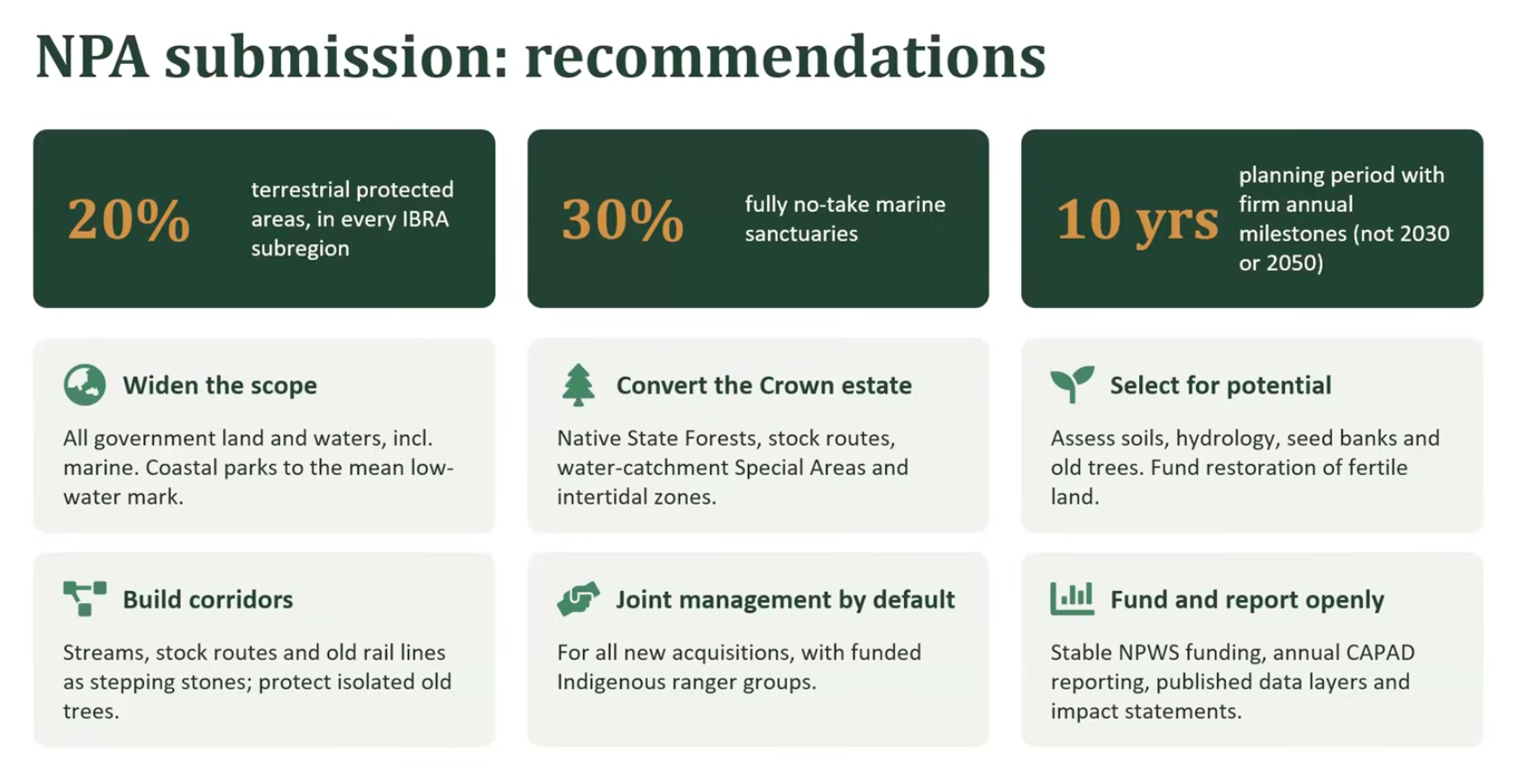
The NPA wants acquisition mapping that accounts for soil health, riverbanks and riparian corridors, tree hollows in forest and on farmland, drinking‑water catchments and intertidal nesting areas along coasts.
According to NPA, the fastest route to extend National Parks is through Crown Lands, State Forests and Travelling Stock Reserves (TSRs).
It wants Indigenous-led land transfers at the core of future strategy.
 NPA NSW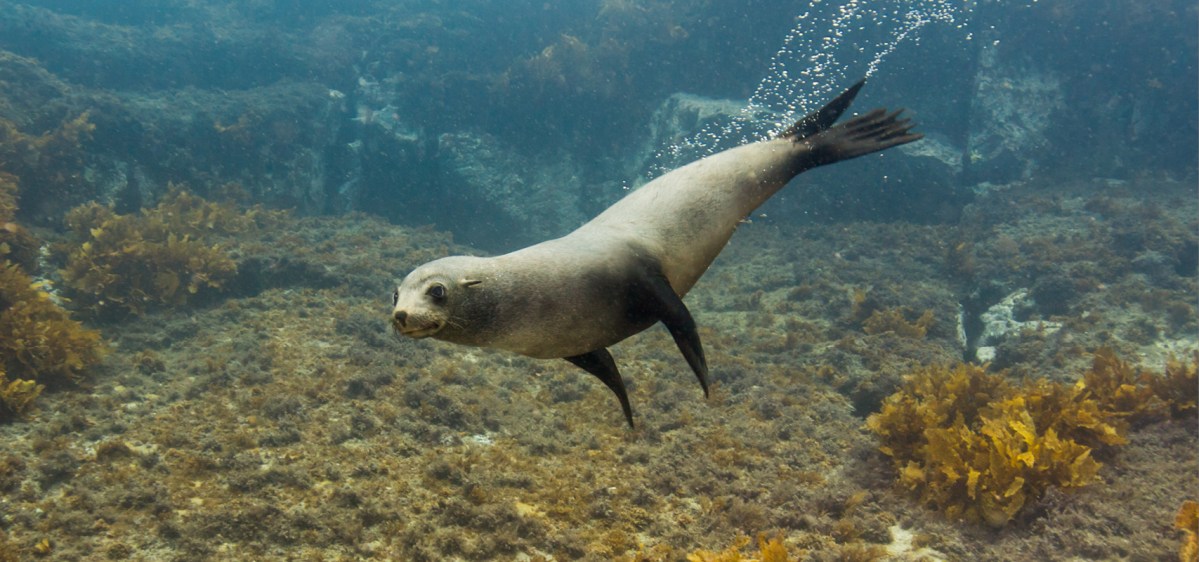
NPA is also among the voices demanding that marine parks be formally integrated into the state's National Park hierarchy - a contentious matter that Ross McDonnell suggested the government may settle in finalising the anticipated NSW Nature Strategy.
Currently terrestrial Protected Areas in NSW are managed by an agency dedicated to nature protection, the National Parks and Wildlife Service (NPWS), under the Department of Climate Change, Energy, the Environment and Water (DCCEEW).
But Marine Parks are legislated as 'marine estates' under the Department of Primary Industries and Regional Development (DPIRD) which manages resource extraction for agriculture, forestry, fishing and mining industries.
So, echidnas may be a protected native species, but snapper are targeted stock.
NPA Convenor of the Landscape Conservation Forum Warwick Pearse said increasing marine no-take zones was a 'no-brainer' because evidence proved that those sanctuaries created more fish in the sea, benefitting recreational and commercial fishers as well as divers and tourists.
But that message isn't cutting through fear of new limits imposed on old habits.
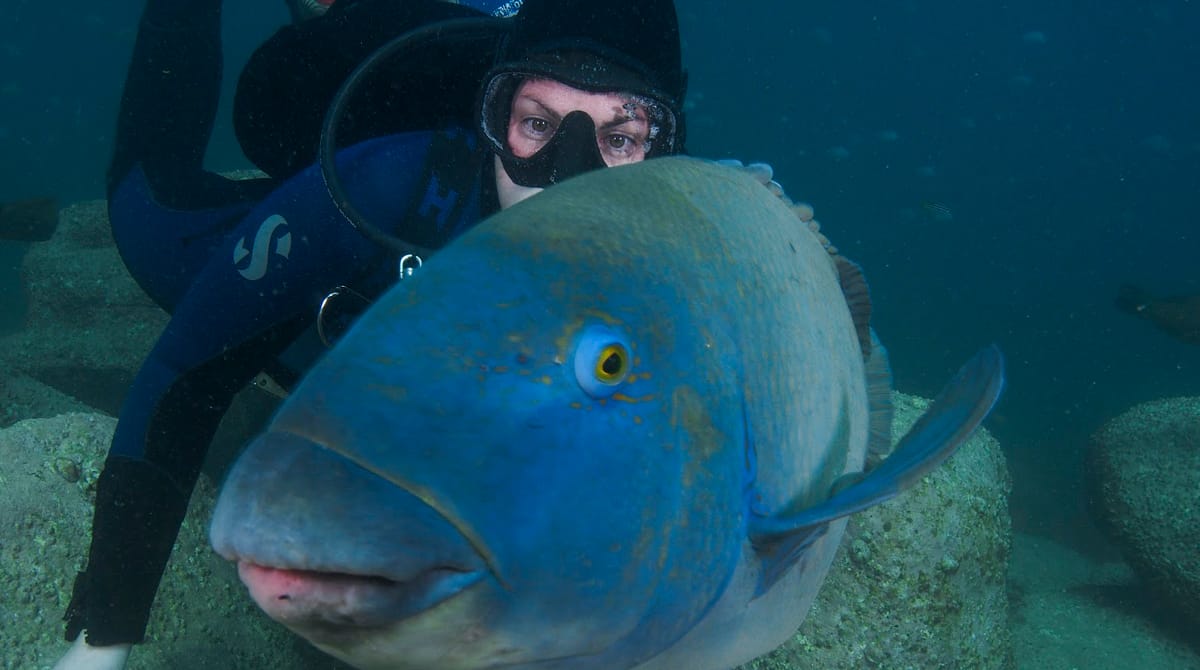
NPA CEO, Gary Dunnett considers it essential to shift responsibility for significant areas from Fisheries (DPIRD) to Environment (DCCEEW) to improve marine conservation outcomes.
Recreational and even commercial fishing are permitted within most Marine Parks and no-take sanctuary zones account for a small fraction of most declared areas.
"No-one would expect koala hunting in a National Park, yet hunting iconic wildlife is commonplace in Marine Parks," Dunnett said.
"NPA's view is that the term 'Protected Area' should only apply to reserves that conserve all of the habitats and species they contain.
"Our recommendation to the NSW and Commonwealth Governments is that the 30 by 30 targets, where a minimum of land and seas are under active management for biodiversity conservation by 2030, should be restricted to no take sanctuaries."
The NPEP, as a National Parks and Wildlife Service (NPWS) framework, was first released in 2008 to solve a long-standing logistical challenge: how to strategically grow the state's conservation areas.
Before then National Parks parks grew ad hoc, mainly from land that nobody else wanted, forming a fragmented patchwork of low commercial value landscapes achieving limited ecological improvement.
New South Wales currently protects 11.3% of its land area in National Parks and private reserves (where 85% of threatened species occur) and less than 7% in marine sanctuary zones.
That effort took 160 years - since the 1866 declaration of Jenolan Caves Reserve as NSWs first protection of a natural feature.
Indeed, the biggest leaps forward in NSW National Park area came from three recent large purchases of private land in 2020, 2021 and 2023.
The NSW National Park estate spans more than 890 parks and reserves, but 12 of 18 bioregions, and 82 of 131 subregions, have less than 15% protection.
Ross McDonnell said the NPEP recommended bioregion protected area targets and timelines in keeping with the Australia's commitment to the United Nations goal of protecting 30% of the Earth’s land, freshwater, and marine ecosystems by the year 2030.
Nationally, Australia needs to protect an additional 57 million hectares of land to meet that committment.
"Clear and honest international targets like 30 by 30 are useful, but they need to be translated into NSW realities," McDonnell and Pearse write in their analysis of the NPEP 2026.
"There should not be vague end dates. A 10‑year planning horizon with annual milestones gives everyone a clear map of progress and makes it harder to keep postponing action to 2050.
"That is really kicking the problem down the road."
McDonnell said 'actionable strategies' exist in the way the National Parks & Wildlife Service (NPWS) aquires land.
He said continuing to rely on land that remained after clearing was merely 'cooking with leftovers' instead of focusing on quality, not just quantity, and prioritising bioregions and threatened species most at risk.
McDonnell said that while he worked for National Parks in western NSW, particularly during drought, landowners frequently asked NPWS staff about buying their land.
"A month wouldn't go past where there wouldn't be one or two landholders on the phone to say they'd like to see if NPWS has an interest in their property."
"That's one valuable actionable element of a parks establishment plan - when dealing directly with a land holder when they make an inquiry, it helps the local NPWS staff know whether there are areas within their patch of statewide or regional significance.
"People talk in local communities and so word gets out.
"NPWS is not able, as a government agency, to go doornocking on properties to say we'd be interested if you want to sell to us - there has to be a transparent communication line which is initiated by a landholder."