
Damned if they do. Divided if they don’t.
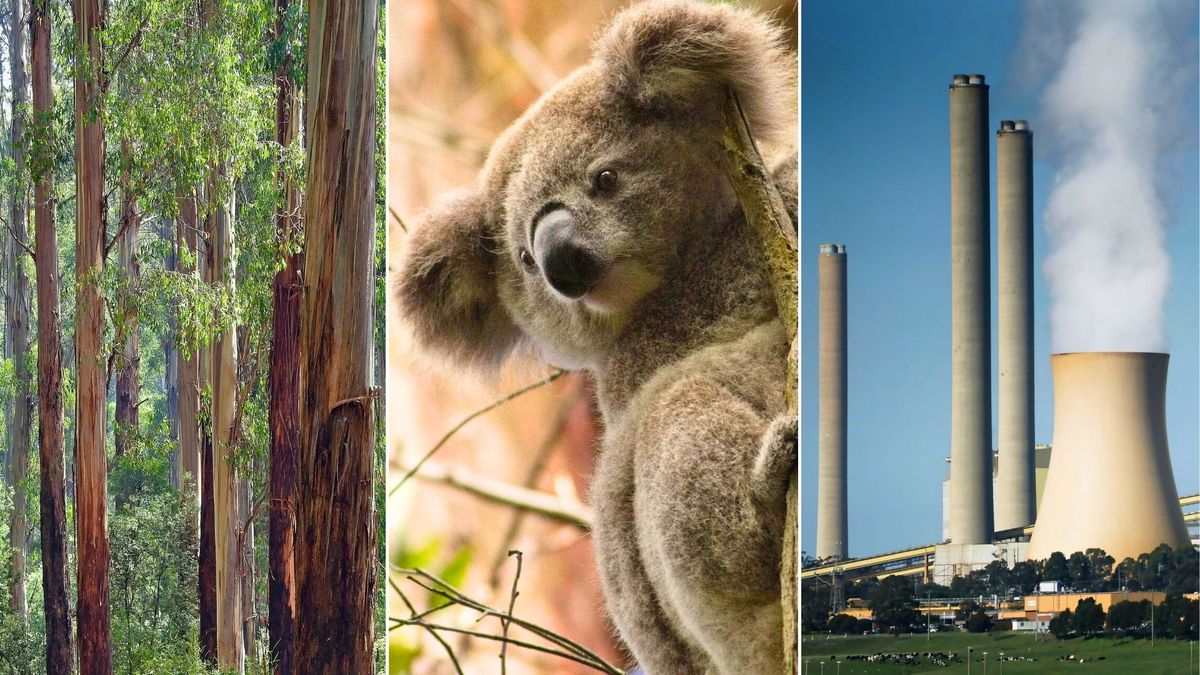
Next week’s Senate vote on the future of native forestry and the Great Koala National Park has split Australia’s environment movement and trapped the Australian Greens between saving nature and saving themselves.
But the architect of the Greens’ torment, Professor Andrew MacIntosh, might also provide the knowledge and leverage the party needs to push for carbon emissions-reduction machinery with sharper teeth.
Many worry that division within environmental politics is dangerous. But public and scientific anger over trading habitat protection for fossil fuel pollution is a warning signal that Labor cannot ignore, and that the Greens could harness.
by Cat Holloway
When the environment makes news headlines, conservationists celebrate. But not this month.
Dedicated forest and climate campaigners who have been brothers in arms for decades were suddenly confronted with the painful choice to either support Labor’s carbon credits exchange for the long-overdue Great Koala National Park, or oppose monetising nature and benefiting polluters to vote with climate change deniers on the far-right.
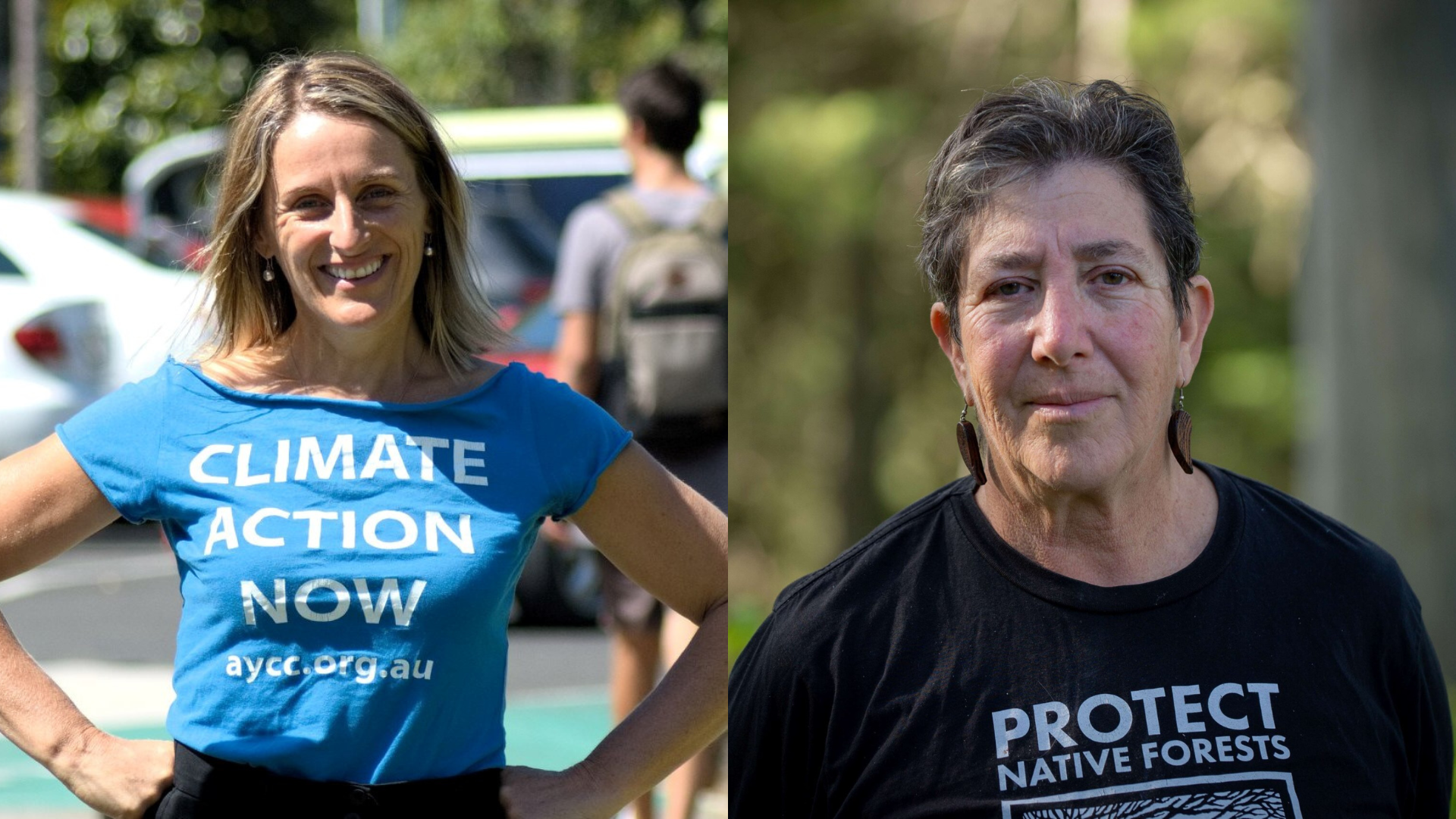
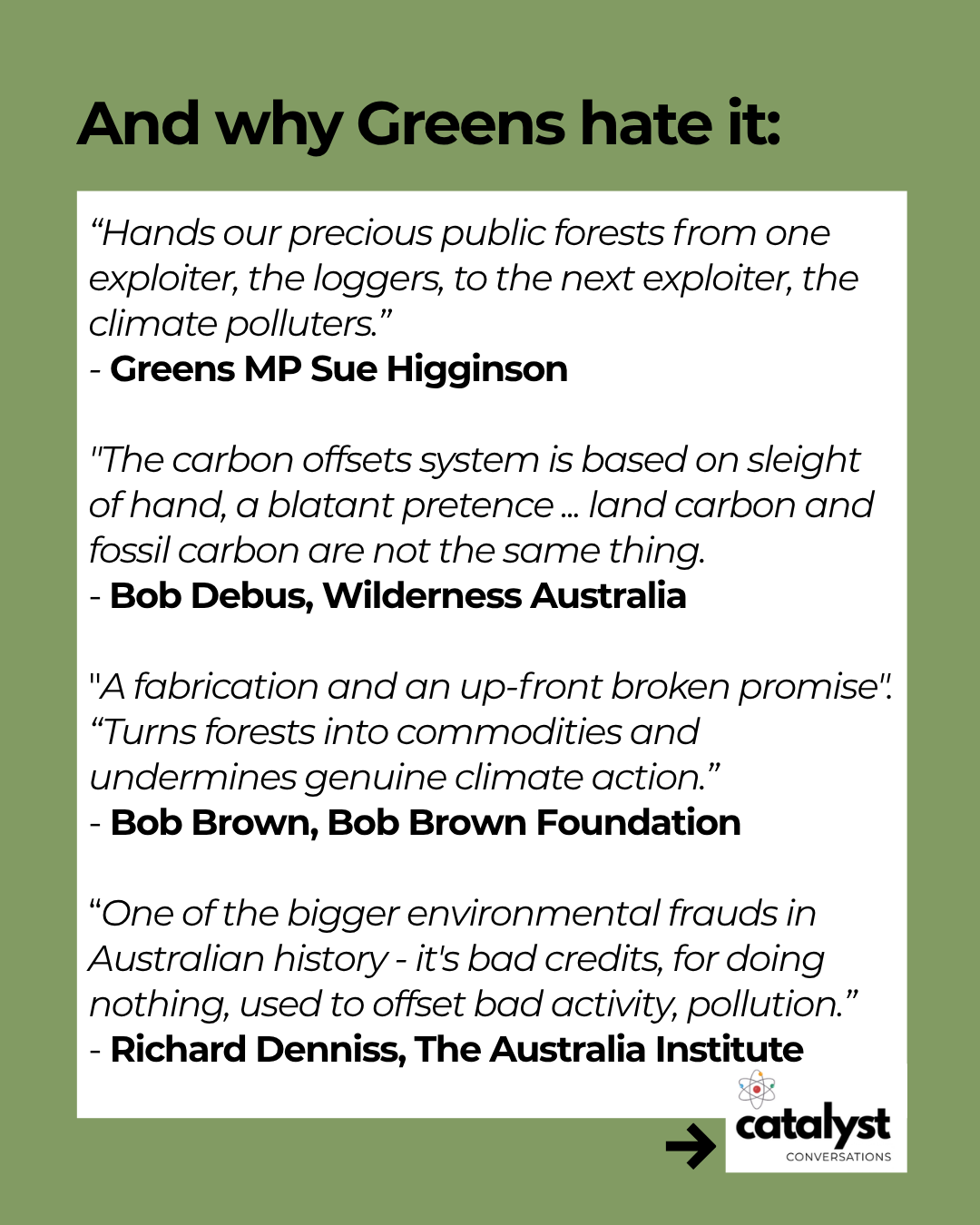
It’s a battle between core principles and desperate need that lifelong forest campaigner and NSW Greens MP Sue Higginson summarised in the Sydney Morning Herald as handing “our precious public forests from one exploiter, the loggers, to the next exploiter, the climate polluters.”
“I hate Labor for doing this to our movement. It doesn’t have to be this way.”
However, Professor Andrew Macintosh, an outspoken critic of 'fraudulent' carbon accounting schemes and the lead author of this new carbon credits plan, is equally unhappy about the way the debate has splintered alliances in conservation and triggered open hostility.
“I’m bewildered by the aggression shown in the debate and the unwillingness of some of those involved to engage with facts,” Prof. MacIntosh said.
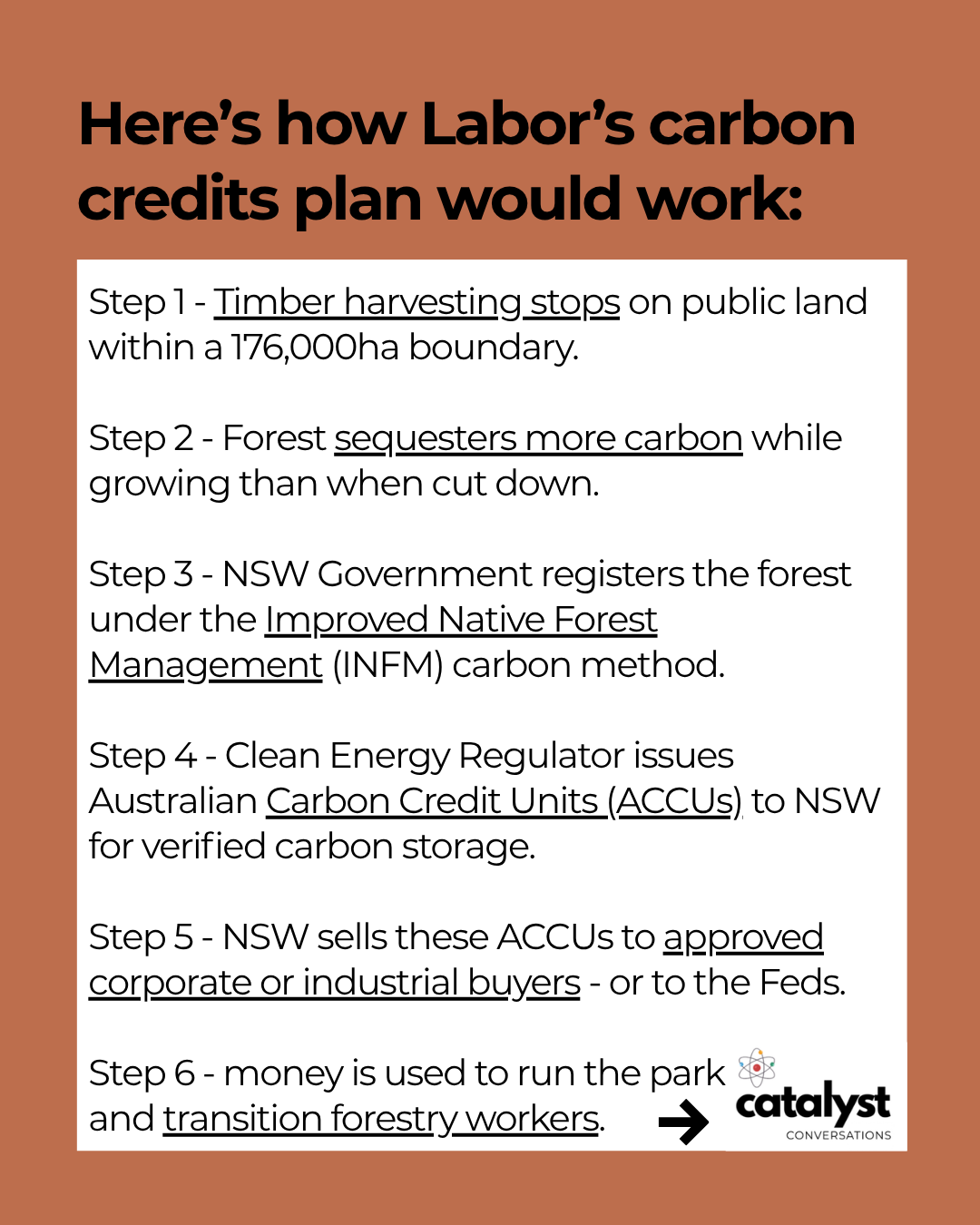
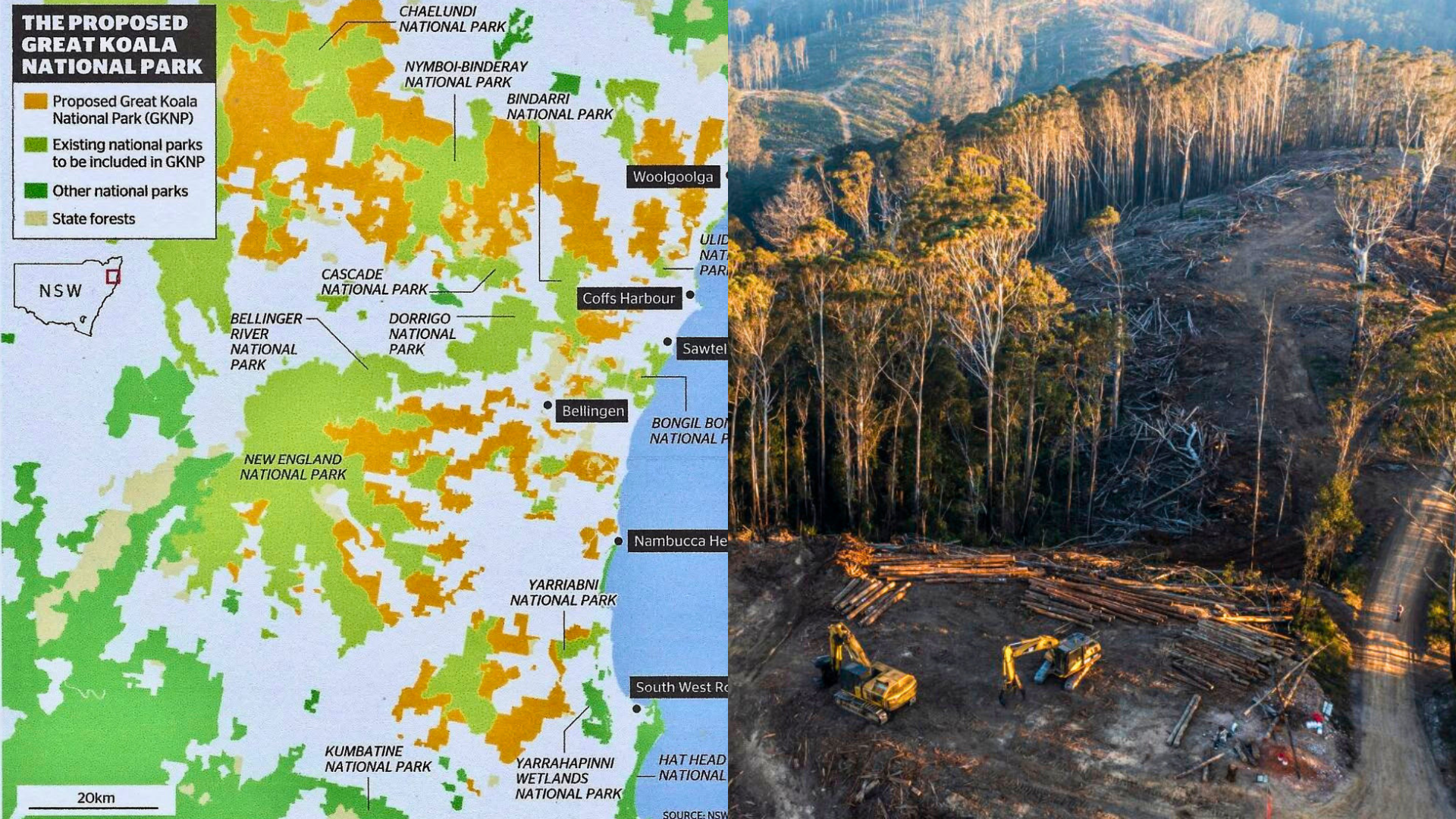
The fracture is over a NSW Minns Labor government proposal that allows state governments to earn revenue from not logging public native forests, then use the funds to create the Great Koala National Park in northern NSW.
Much of the vitriol centres on the opinion that NSW Labor devised this strategy as an escape from a decade of election promises made to end heavily subsidised logging in over 176,000 hectares of state forest, and connect it with existing parks and reserves to declare a new 476,000-hectare National Park.
In June, the Albanese Labor government approved the new accounting structure called the Improved Native Forest Management method (INFM).
But Nationals Senator Ross Cadell lodged a “disallowance motion” against the INFM because it would hasten the demise of the native forest industry. The vote to abandon or save the INFM happens on Tuesday, August 18.
A Senate decision to strike the INFM down would need Liberal, National, Green, and some crossbench senators voting together, albeit for very different reasons. But if Greens stand with Labor, the INFM survives.
Greens Senators are yet to announce a position, and intense negotiations are likely still underway as MPs wrestle with rescuing crucial koala forest or going against a fundamental tenet of Greens voters and environmentalists: protect nature for its intrinsic existential value, not for trading on a market that greenwashes the pollution of the fossil fuel industry.
As lead author of the INFM and Director of the Centre for Environmental Markets at the Australian National University College of Law, Governance and Policy, Professor Andrew Macintosh is as confident in his carbon credit accounting as he is personally conflicted.
Presenting a technically detailed explainer to a Nature Conservation Council webinar on how the INFM has extra integrity mechanisms and tighter controls, Prof. Macintosh and Professor David Lindemayer agreed there were good and bad environmental planning projects and particular problems with much of the Australian Carbon Credit Unit scheme (ACCU).
"If you've got concerns about ACCUs, I share them. I think the whole market is dominated by a bunch of stuff that is basically fraudulent," Macintosh said.
"And if you're concerned about the ACCU market artificially suppressing the carbon price, I'm with you, and I'm your ally.
"If people want good climate policy, what does it look like? Well, it looks like imposing some sort of carbon price, a decent carbon price, on polluters.
"But you're always going to need some mechanism to cap that price. The politics can't stand a super high price.
"My personal preference is we just tax them. A carbon tax. It applies to all their emissions. Then you accumulate the funds and you distribute them to good things that help us cut emissions and sequester carbon in good places.
"I certainly wouldn't oppose the federal government paying state governments... to facilitate the structural adjustment that needs to happen with shutting down native logging.
"I also don't oppose things like giving landholders money to plant trees in their landscape and making sure they keep them.
"And I don't see there's much difference between what this method does, what the environmental plantings method does, and that form of climate policy."
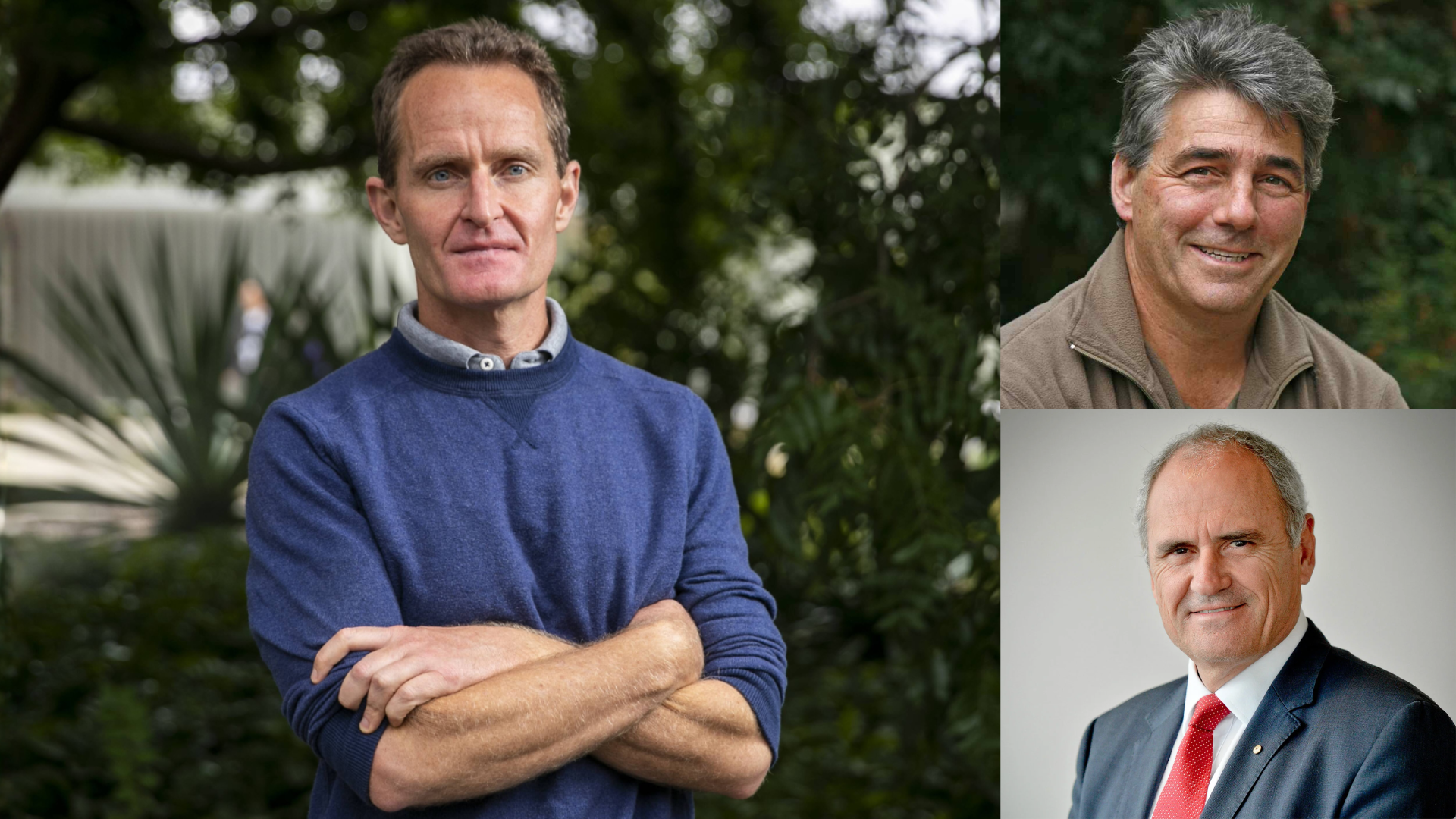
Macintosh said he understood why environmentalists question why we can't conserve forests without ACCUs
"I don't want to be seen as an outright advocate, but I think there are a number of positives that come from doing forest conservation through this method. And the first one on the list is that stopping means stopped."
"Anybody who's been watching what's happened after the Victorian government supposedly shut down native forestry - it really hasn't happened.
"They're just carrying out harvesting under different names. Whether it be forest gardening or fire protection and a whole bunch of other things, it continues.
"If you have a project, an INFM project where they have to stop harvesting within an area, they must stop it - and it has to be stopped for 100 years."
Macintosh said the INFM caps across the whole network of estates and reserves would control the historic tendency of forestry to simply "jump the fence" and increase the intensity of harvesting timber outside national park boundaries.
"Let's just say that the NSW government did a Victorian government and continued to clear and harvest in protection areas. Well, the New South Wales government wouldn't get any credits and the project will be deregistered. That's how the method has been set up."
Macintosh also said that a future government wanting to exit the INFM would have to surrender their ACCUs and "buy their way out".
He discussed the importance of using satellite imagery and his team's VMAP vegetation monitoring database to track, in high resolution, canopy cover changes across Australia.
"There has to be some trust in government, but if you want someone who's sceptical of government, you're talking to him, and that's why I think those transparency mechanisms are so important."
"It gives everybody the capacity to monitor the forest themselves, a hell of a lot better than what is currently happening now."
Macintosh said the INFM method "lent on the scales to make sure that the calculations are deliberately one-sided" and "necessarily conservative".
For example, the method excludes credits for soil carbon, a source of emissions after harvesting disturbance. It excludes fossil fuel emissions associated with increased harvesting. It excludes paper and cardboard, methane emissions from harvested wood products and landfill.
MacIntosh has not been a dominant voice in the media as this debate has developed (hence, this article). But his work has copped intense criticism from both sides.
The forestry lobby claims MacIntosh is hypocritical to openly condemn Australia Carbon Credit Unit (ACCU) schemes while designing one of his own.
The environment lobby says his method sells nature out to polluting industries seeking to greenwash profits.
Catalyst asked MacIntosh if Labor's approach was a proverbial can’t see the planet for the trees scenario.
He said it was true that forest campaigners were keen to use the INFM to push for more protected reserves and less native forest logging. But to climate campaigners angered about favouring polluters by suppressing the carbon price, he said the credits in this project would not be anywhere near enough to have such an impact.
“If groups are really concerned about the ACCU scheme, why pick this method as the one to fight on with such venom?” MacIntosh said.
“Where was the concerted effort to oppose the Landfill gas method that went through last year, which is responsible for 27% of ACCU issuances and has marked integrity problems?
“Where was the concerted opposition to the soil carbon method, which was just reviewed?
“Where is the group effort to oppose the continued 9.5 million ACCUs per year going to human-induced native forest regeneration projects in uncleared ecosystems in the outback, including in the Nullarbor and adjacent to the Simpson Desert?”
Leading the charge to demand Greens reject the INFM is The Australia Institute (TAI), asserting that The Australian Conservation Foundation, the Bob Brown Foundation, The Wilderness Society and Wilderness Australia had joined more than 50 other conservation groups in solidarity against a trees-for-emmissions swap.
TAI's prominent multi-pronged push saw co-CEO Leanne Minshull write in The Point that a party founded to protect the environment cannot agree to monetise it. Minshull held 1.88million Greens voters up as ransom, arguing that it would be harder to face a disappointed electorate than to vote with One Nation/LNP even though anti-Net Zero policies bow to the fossil fuel industry.
She said the Greens acceptance of the INFM would be an admission that their power is limited and show "a lack of faith in the people of Australia to mobilise and protect the environment."
"Privatising the protection of nature is problematic. Australian governments have a mixed report card for delivering public services. But for corporations there is no grey area – they have only ever failed," Minshull wrote.
Dr Richard Denniss (Australian Institute co-CEO) wrote and spoke widely on forest protection being used to greenwash coal and gas, warning of "phantom credits" and 40–100% over-crediting, also citing TIA polling showing most people distrust offset mechanisms but want the Great Koala National Park.
Meanwhile, more convincing pleas came from Greens founder Bob Brown (now leading the Bob Brown Foundation) and former Labor Environment Minister, Bob Debus, (now chair of Wilderness Australia) who have both spent a lifetime on the frontline of environmentalism, particularly saving Australia's forests.
Debus said Green support for the INFM would amount to "a preemptive buckle instead of action to hold the line for nature and climate change abatement."
"When carbon credits...are traded as offsets, they don’t reduce emissions: they maintain the status quo."
"The system of carbon offsets is based on sleight of hand, a blatant pretence ... land carbon (green carbon) and fossil carbon (black carbon) are not the same thing.
"Moreover, the INFM method does still depend upon a number of quite unrealistic assumptions: that climate change will make no difference to the severity of bush fires in the next 100 years; that logging will continue over the next 15 years; that governments will make no attempt to protect forests for at least the next 15 years if ACCUs are not created."
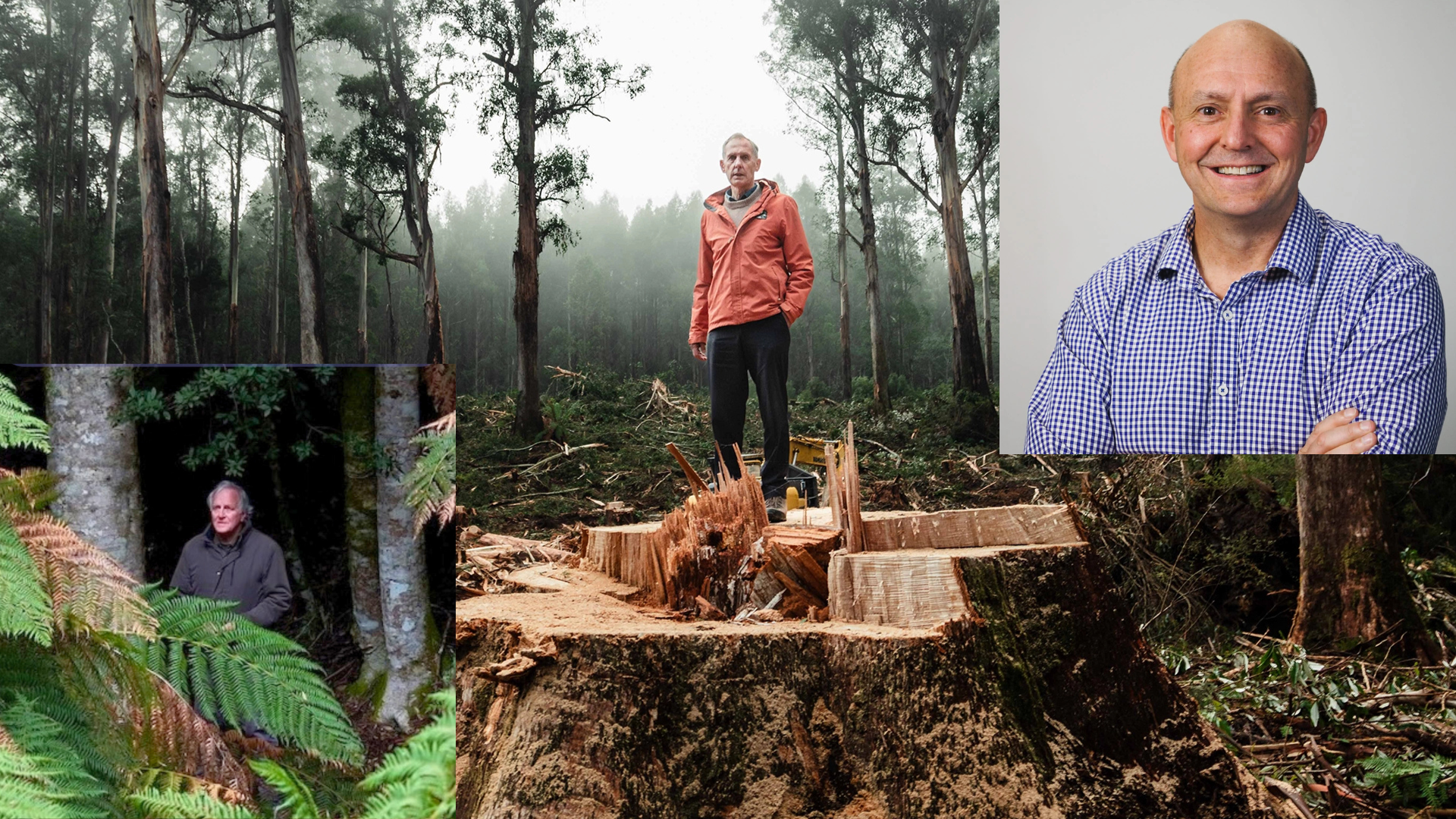
Bob Brown argued in his scathing Why Anthony Albanese Hates the Greens piece that NSW Environment Minister Penny Sharpe's claim that the INFM "must" be approved for the Koala National Park to happen is a "fabrication and ... an up-front broken promise".
Brown's Foundation campaign urged members to write to Federal Greens senators demanding carbon credits be rejected for NSW forests because they set a dangerous precedent for: turning forests into commodities, eroding climate action, allowing more pollution and weakening the purpose of national parks.
On the other side, the INFM has enthusiastic advocates, most prominently Dr Ken Henry as chair of the Australian Climate and Biodiversity Foundation (ACBF) who recently addressed the Clean Energy Council summit, claiming both conservatives and conservationists were "undermining progress" during "dangerous times for climate policy".
Henry's perspective is influenced by his personal background (his father was a timber worker on the mid-north coast of NSW) and his professional expertise as an economist and former Treasury Secretary, intimately involved in the rise and fall of Australia's early push towards emissions trading and carbon pricing.
"In 2013 we lost everything; it is almost as precarious as that now," Dr Henry said.
"Support is being fractured by those who, for whatever reason, oppose the use of carbon offsets, full stop.
"But I tell you this, if we cannot make carbon offsets work, if we cannot make ACCUs work, we will lose a lot.
"But we have been in more difficult places in the past. I think what's needed is for people of goodwill to come together and to figure out how we do this."
The ACBF and Dr Henry aim to progress environmental causes through collaboration between conservation, government and the private sector.
The organisation's board of five includes David Mackenzie, who was listed as (and may still be) Program/Environment Director for the Angela Wright Bennett Foundation, although his bio on the ACBF website doesn't mention that.
Angela Wright Bennett is the Australian mining heiress and head of Wright Prospecting, a private Perth-based mining company founded by Pilbara iron ore pioneer, Peter Wright, the business partner of Lang Hancock.
Journalist Stephanie Tran for Michael West Media dug into the dollars behind the ACBF and other conservation groups advocating for carbon credits.
The Australian Climate and Biodiversity Foundation was established in 2021 and has received $27.8m in donations while distributing $2.8m in grants to other organisations.
Neither ACBF nor the Angela Wright Bennett Foundation said whether the ACBF was established with donations from the Angela Wright Bennett Foundation, saying it “respects the confidentiality of its donors and grant recipients".
The ACBF said it does not fund election campaigns.
The Nature Conservation Council of NSW, the North East Forest Alliance and the National Parks Association of NSW declined to comment on its donors.
But the National Parks Association (NPA) acknowledged in internal communications that it “has received funding from the Australian Climate and Biodiversity Foundation (ACBF) for part of its GKNP campaign, and more recently for its 30 x 30 campaign”.
"While NPA acknowledges the flawed history of land-based carbon offsets, the strict 100 year permanence and full logging cessation rules built into INFM represent a fundamental break from previous models.”
Tran reported that WWF-Australia would not confirm whether it had received ACBF funding, stating it supports “high-integrity carbon credits that cannot be sold to fossil fuel companies”.
Greenpeace also did not confirm whether it had received funding, but said it maintained that fossil fuel companies should not have access to carbon credits.
The Biodiversity Council said it had not received any financial support from ACBF.
Philanthropy from wealthy businesspeople is crucial to sustain environmental causes, but the lack of transparency about connections between mining interests and carbon credit advocates triggered doubts.
Meanwhile, The Guardian questioned money flowing to The Australia Institute.
Minderoo, the charity arm of Andrew Forrest's Fortescue Metals Group, made an undisclosed donation to The Australia Institute ("allegedly six figures"). Both organisations campaign against using carbon offsets to reach net zero emissions by 2050, instead championing a “real zero” strategy and total decarbonisation.
Internationally respected forest ecologist, Dr David Lindenmayer, who advised on aspects of the INFM alongside several other academics, said a distrust of carbon offsetting is justified.
 David Lindenmayer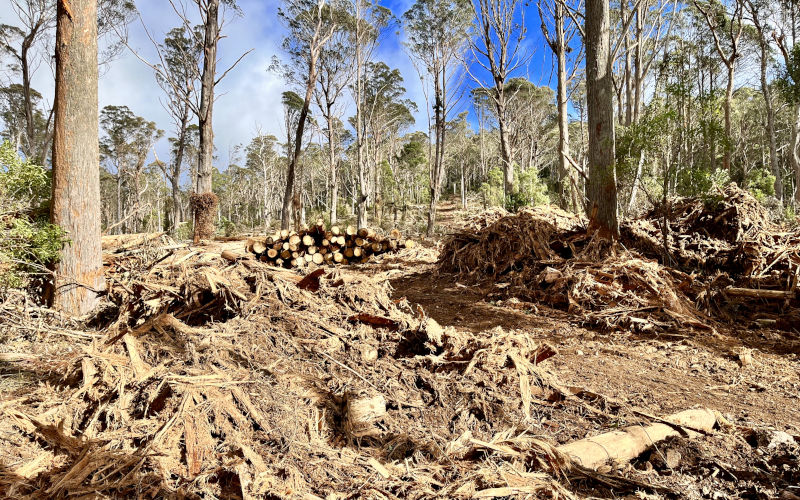
But his support of the INFM comes after years of vocally recognising the urgency of protecting remaining forest habitat and biodiversity - with a passion that other climate scientists and ecologists have not had the courage to display.
Lindenmayer's research also showed that logged and regenerated forests are more flammable than intact (unlogged) forests.
"In Australia, logged and regenerated native forests are four times more likely to burn than plantations. Failing to take this chance is a serious mistake we cannot afford to make."
- David Lindenmayer
He said issuing carbon credits for stopping logging makes scientific sense because native forest logging generates large amounts of greenhouse gas emissions by releasing the carbon stored in the trees and soils into the atmosphere.
He said logging a forest estate repeatedly also prevents the forests from growing and sequestering increasing amounts of carbon, instead reducing stores to half their potential.
The broader carbon credits policy goes beyond the Great Koala National Park and the INFM to the country's flagship climate policy, the 'Safeguard Mechanism'.
The Safeguard Mechanism sets a legal limit - or baseline - on direct emissions of around 215 large mining, manufacturing, oil and gas sites. Those companies can cover excess emissions by surrendering Australian Carbon Credit Units (ACCUs).
But TIA and environment groups have slammed the Safeguard for failing to actually reduce emissions while rewarding polluters - in the case of the Great Koala National Park companies could pay for trees that were never at risk of being felled.
Greens will certainly demand that the INFM exclude fossil fuel businesses from offsetting through the method. Penny Sharpe has already claimed her environment department would shut those polluters out, but the decision is in Federal hands.
There are avenues for Greens to use their balance-of-power position on this INFM disallowance to negotiate a commitment from Labor for higher integrity ACCUs.
The Climate Change Authority is currently preparing its fifth review of the ACCU Scheme for delivery by the end of 2026.
According to Dr Ken Henry on ABC radio:
"That review is just kicking off now and has to result in tougher carbon abatement requirements."
"Business is already saying the Safeguard Mechanism is too tough, that it should not be extended, that the abatement requirements should not be made tougher.
"But on the other side, we've got the Climate Change Authority telling us in report after report after report, that if Australia is to have any chance of meeting the net-zero by 2050 target ... the Australian land sector is going to have to sequester, draw out of the atmosphere, two and a half times as much carbon each year as it's presently doing.
"The only mechanism we've got for doing that is carbon offsets."
North East Forest Alliance campaigner, Susie Russell, lamented the public pressure on Greens to stand with their political enemies and reject the INFM.
"I think it would be political suicide for the Greens to support this disallowance motion," Russell said.
"How's it going to be when the Greens are campaigning for forest protection in the next election, and the ALP says, 'Oh, we'd like to do that, but you know, you Greens, basically took away our pathway to be able to do that.'
"The Greens need Labor to pass measures for forest protection. Labor needs the Greens' preferences. It's a great opportunity for them to work together, and it would be a real shame if that opportunity was squandered."
It might be true that the Greens are in a no-win situation on the specific INFM vote next week.
But it's possible that the Nationals and the Australia Institute did the Greens a favour, elevating this technically dense INFM in the media to controversy, testing the dedication of environmentalists and proving how impossible it is to please everyone, even when they want the same thing.
What Sue Higginson called "white hot pain and anger" over koalas, native forestry, species extinctions and climate resilience should help Greens illuminate for Labor the visceral connection Australians have with nature and voters' valid fear of more climate-change-driven fires and floods.