
From shellfish to shell grit: The bitter reality behind Marine Park mariculture dream.

Jervis Bay's mussel farm shifts its strategy from gourmet food to animal health products. But are pet supplements worth risking Jervis Bay Marine Park's unique ecology?
by Cat Holloway
In summary:
JB mussel farmers have faced sewage contamination, algae blooms, barnacle coverage, warm water and unresolved controversy over species invasiveness.
New CEO says omega-3 protein powders for pets and shell grit for chickens provide a more sustainable farming pathway than the food market, despite that the farm's key "State Significant" licensed purpose was food production.
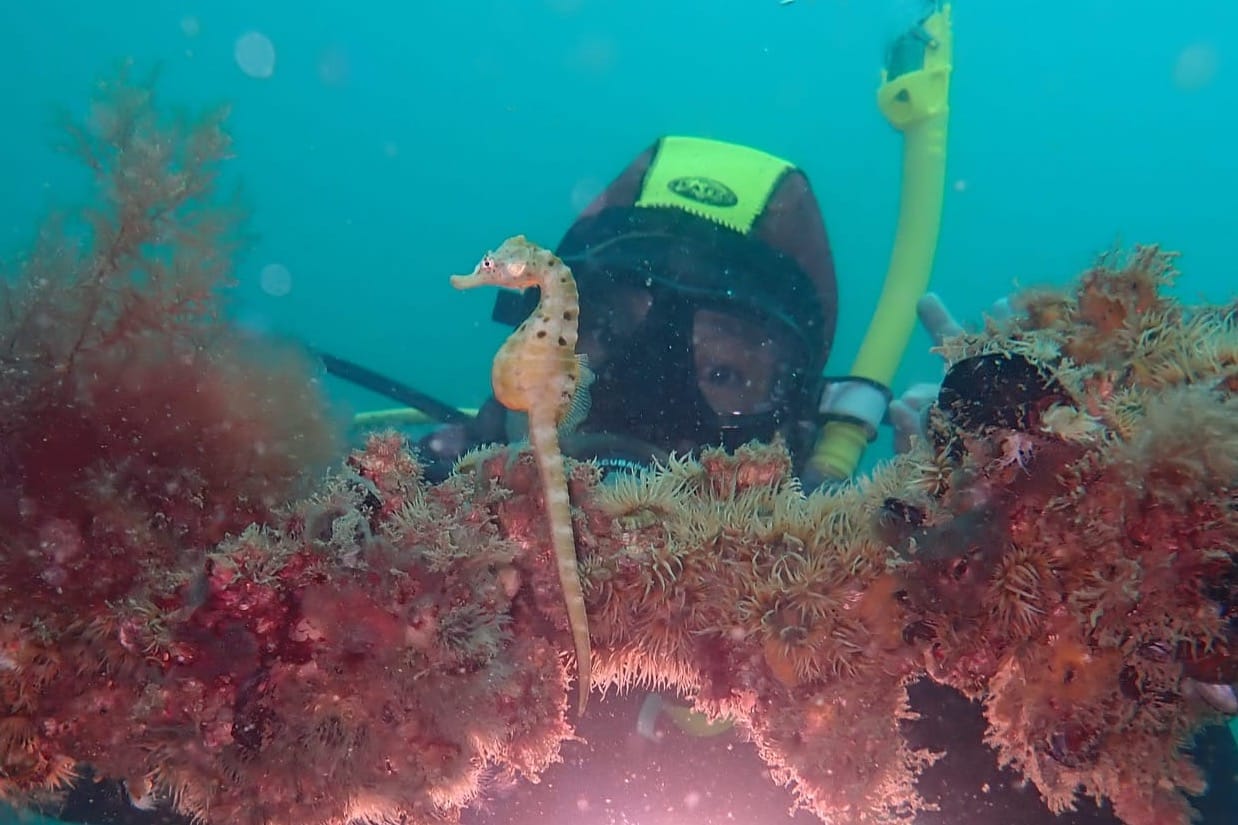
Scientists and tourists fear mussel farming within a marine park will cause animals to change behaviour and bycatch, like protected seahorses, to die. Divers continue to photograph Jervis Bay reefs blanketed in blue mussels.
NSW Department of Primary Industries and Regional Development has increased statewide aquaculture funding. But required genetic testing and benthic survey results from its Jervis Bay mussel farm remain unpublished.
“Good intentions may do as much harm as malevolence, if they lack understanding.”
- Albert Camus, The Plague
It’s another glistening morning in Jervis Bay on the South Coast of New South Wales.
The resident pods of bottlenose dolphins speed past boaters, breaking into smaller hunting and herding parties spread across the bay. Grey nurse sharks emerge from between boulders, gulping fresh air at the surface so they can cruise effortlessly buoyant among frenetic schools of yellowtail scad. Octopuses form strange societies around dens built from discarded scallop shells where they fight over territory, upending preconceived ideas about octopus as solitary creatures.
Little Penguins waddle across Bowen Island's rocky shore, in small squads to avoid sea eagles, before diving to forage until dusk. Early in the summer, a Southern Right whale brought her calf close enough that beach walkers could watch them lolling about. And in winter, the regular humpback whale migration will attract thousands of visitors to marvel at and swim with the gentle giants.
Cetacean experts from several universities work with local citizen scientists to study Jervis Bay's whales, dolphins and seals. Marine biologists from around the world come to film 'Octopolis' and 'Octlantis'cephalopod cities. And an international shark scientist alliance recently designated Jervis Bay an ISRA (Important Shark and Ray Area) for the large aggregations of critically endangered Grey Nurse Sharks, the presence of Eastern Fiddler Rays and the nursery grounds of Port Jackson Sharks.
You could be excused for using cliches like pristine and paradise to describe Jervis Bay.
After all, as one of six NSW Marine Parks, the perception that Jervis Bay is protected is its key appeal as part of Shoalhaven’s $1.5 billion annual tourism economy— the largest outside Sydney.
But Jervis Bay is not a 'marine park' in the same vein as The Great Barrier Reef or Ningaloo, which are managed by State and Commonwealth conservation agencies.
In NSW, marine parks are actually 'marine estates' managed by the Department of Primary Industries (DPI) with a "focus on Fisheries, Forestry, Agriculture, and Biosecurity."
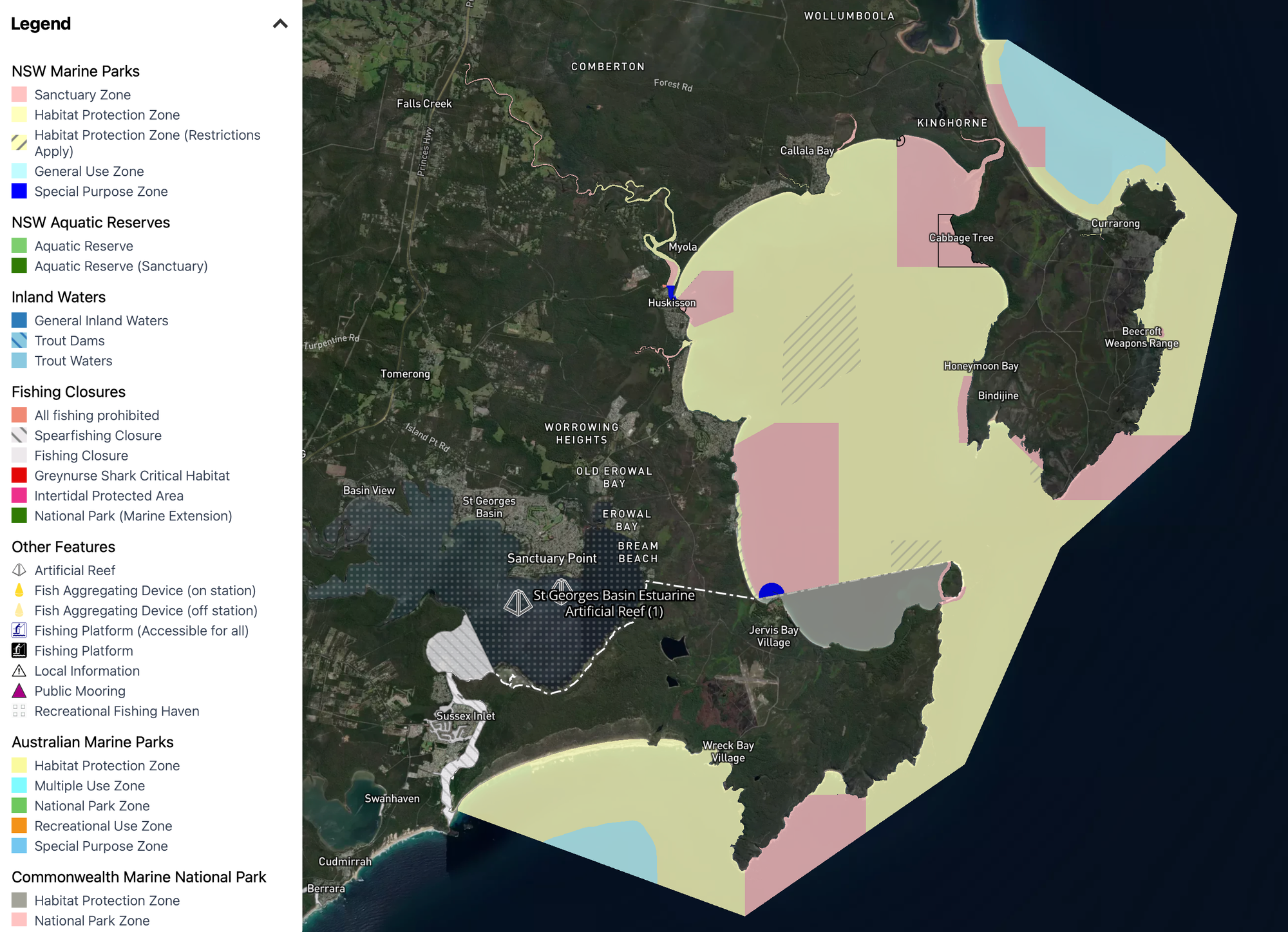
Just 20% of Jervis Bay Marine Park is zoned no-take sanctuary. While 72% is zoned 'Habitat Protection' which allows recreational and some commercial fishing.
In 2014, NSW repealed its 1997 Marine Parks Act and entirely replaced it with the Marine Estate Management Act.
During that legislation change, the DPI pushed Jervis Bay Marine Park as a prime location for mariculture - specifically licensing South Coast Mariculture (SCM) to farm blue mussels in a State Significant Infrastructure of three lease areas originally covering 50 hectares (ha), then extended in 2025 to 70ha.
This license to farm mussels - and oysters - within Jervis Bay has put SCM and its Jervis Bay Mussels brand at the centre of a tug of war between those who see Jervis Bay as a resource to maximise and those who want its biodiversity conserved.
"The reason I'm a shellfish farmer is because I think it's a way to grow food that's going to save the planet."
- Scott Walter, CEO Blue Harvest/SCM
Scott Walter is the CEO of Blue Harvest, the seafood marketing parent company of South Coast Mariculture that farms and sells the Jervis Bay Mussels brand.
He has worked in aquaculture since his early 20s and was excited by culturing mussels as a sustainable protein source with 'low infrastructure requirements'.
“I've spent a lot time in prawn farming and that has much bigger impact on the environment than mussel farming,” Walter told a Callala Beach community meeting last December.
“I’m a passionate hater of salmon farming, for a number of reasons. One is the awareness of some people in that sector and the greed, just the factory approach to the way they farm.
“There are not that many types of farming of any type of food on this planet that is as low impact as mussel farming.
“Nothing’s perfect, there’s no perfect food production, even monoculture of fruit has environmental impact, it’s not natural."
Walter was head of operations at Blue Harvest/SCM until founder and Managing Director Sam Gordon stepped away and handed Walter the reins in April 2025.
DPI had just given South Coast Mariculture (SCM) permission to expand its farming of the Jervis Bay Mussel products across a total area of 70ha sited 1.5km offshore from the famously white sands of Callala Beach.
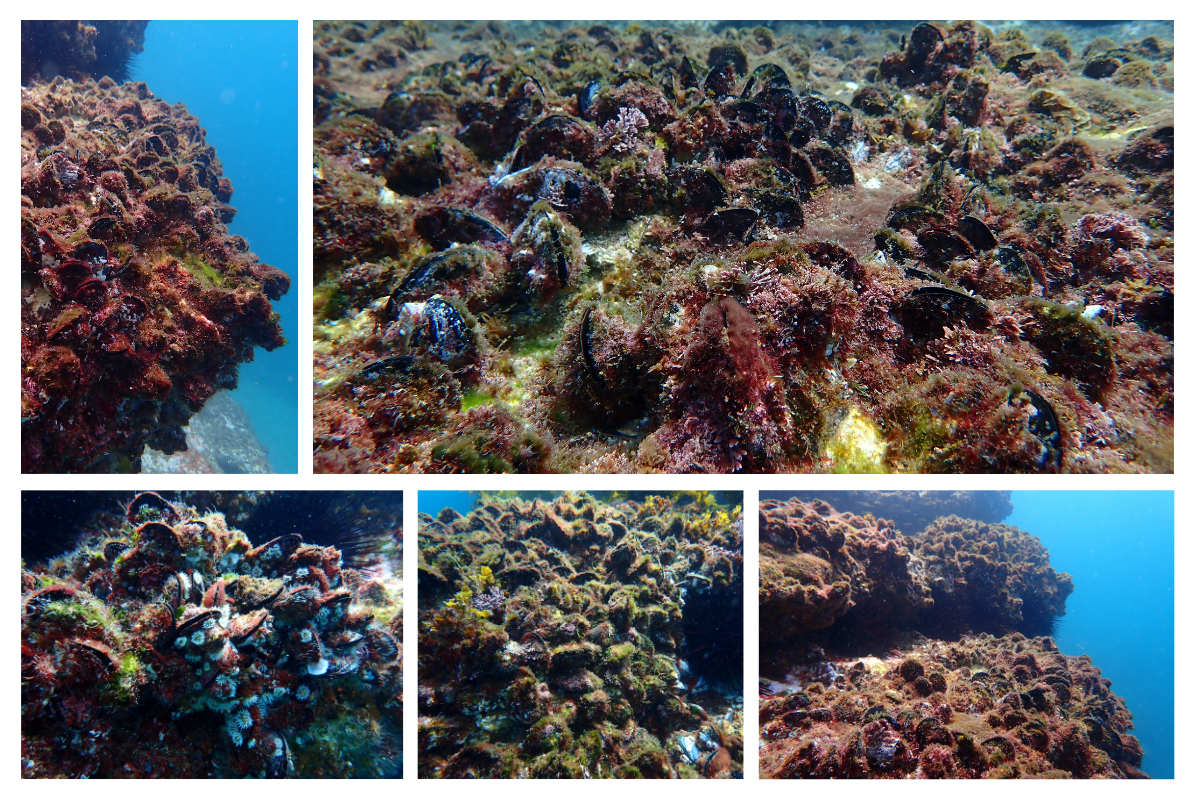
Before the expansion was allowed, SCM and its governing body, the Department of Primary Industries and Regional Development (DPI for simplicity) faced public criticism after dramatic underwater images showed blue mussels covering shallow reefs in Jervis Bay Marine Park and clustering on boats and docks in a way divers and fishers said they had never seen.
“If there is doubt, we should pause - because we cannot risk the ecology of a place as important as Jervis Bay."
Conservationists, tourism operators and DCCEEW scientists called for immediate investigation into the spread of mussels from the farm and the potential invasiveness of the species being farmed. But the DPI approved the farm expansion regardless.
Managing Director at the time, Sam Gordon, confronted community fears in a public meeting and in media interviews, but he denied that his farm was responsible for the unprecedented colonies of blue mussels appearing on shallow reefs within Jervis Bay, saying it was merely a "natural boom and bust cycle".
Gordon also quoted SCM's benthic surveys as evidence that mussel mounds were not forming under the farm, beyond the infrastructure and out of the farm's control, despite local divers capturing images of exactly that.
Even contradictory science and a majority of formal opposition did not stop South Coast Mariculture’s expansion.
"They are risking the Golden Goose that lays the eggs."
In fact, Gordon told The Farmer magazine in 2023 that when harvesting was stopped for 25 weeks in 2022 following floods and algae blooms, mussels fell to the seafloor "as the mussels continued to grow and eventually became too heavy for the ropes".
The farm licence now requires harvesting to occur before the mussels spawn 'if possible'. But Gordon said "it would take an act of God" to control spawning.
Gordon said divers and ecologists were 'jumping at shadows' in their calls for DPI and SCM to apply the 'precautionary principle' and complete genetic and spatfall research before expanding mussel mariculture in the marine park.
He urged for peer reviewed scientific literature to be the sole source of information on the matter. But community members had already communicated with scientists and reviewed the extensive published science, which only fueled their opposition.
DPI and SCM's defence of its mussel farm rested on their unyielding position that the Blue Mussel being harvest was a safe 'endemic' or 'native' version of the Mytilis galloprovincialis species known elsewhere from the IUCN list of the "100 World's Worst Invasive Species".
M. galloprovincialis has proven invasive in a variety of habitats outside Australia, quickly dominating native species and adapting easily to warming seas. In New Zealand's mussel industry, M. galloprovincialis 'blue mussels' are considered an invasive 'biofouling' threat to the lucrative greenshell mussel industry. Some NZ farmers have moved to process blue mussel bycatch into feed for other aquaculture stocks such as prawns.
Ambiguously, DPI changed the name of the blue mussel farmed in NSW from M. edulis to M. galloprovincialis but claimed (contrary to its own quoted scientific sources) that it was genetically closer to the native blue mussel M. planulatus.
Recently, DPI changed its position again and recognised that the blue mussel farmed in NSW was a hybrid of the introduced M. galloprivincialis and the native M.planulatus. Whether M. galloprincialis arrived in eastern Australia recently or not is central to debate about whether the mussel is endemic, invasive, or both.
If you are confused, you are not alone. Hence the pressure on DPI to release results of genetic testing and spatfall assessments that was supposed to happen within six months of the mussel farm's new permit. A year on, a DPI media statement said:
"The Department has sampled wild and farmed mussels from Jervis Bay and other parts of southern NSW for genetic assessment and is also assessing spatfall in those areas. The Department expects analyses of the first year of data to be complete later this year. Results from the program will be shared with the stakeholder community advisory group and published on the DPIRD website when they become available."
Scott Walter expressed frustration with both the pace of bureacracy and the weight of 82 regulatory conditions he said were applied to SCM and Jervis Bay Mussels.
He offered to collaborate with local divers to monitor mussel growth around Jervis Bay, but that idea fell flat over fundamental disagreement on the science surrounding the species and its invasiveness.
Meanwhile, DPI actively blocks its own scientists or managers from sharing their observations or opinion. (For this article and previous interviews, I was asked not to communicate with any DPI staff outside the media unit.)
But Scott Walter has shown his willingness to engage with community about the challenges of farming mussels in Jervis Bay - as well as the solution he considers sustainable.
“It hasn’t been an easy project. There were probably some stars in people’s eyes from the very beginning,” Walter said.
“The last few years of heavy rain have had a major impact. You can’t harvest when the water is dirty.
“The sewage treatment plant at Moona Moona Creek has overflowed several times…so every time we had to close the farm for 21 days over concern about bacteria and viruses in the water, and obviously, as filter feeders, mussels absorb all of that."
According to Our Future Shoalhaven's Dr Evan Christen, an agricultural engineer and ex-CSIRO resource management researcher, DPI 'rammed through' the mussel farm without baseline information about the environment and the risk of uncontrolled mussel spawn.
"These mussel farms are a crazy ideological push from Fisheries because they don't care about Marine Parks.” Dr Christen said.
The impact of algae was not anticipated, even though seasonal algae blooms are well-documented in Jervis Bay, and Port Phillip Bay mussel farms had previously suffered setbacks from algae loads.
Blue Harvest’s 2024-2025 report noted: “a naturally occurring algal bloom of the Rizosolenia species in August 2024 left the mussels unmarketable in Jervis Bay until November”.
“This particular type of algae gets stuck in the gut of the mussel and irritates it and makes it taste bitter,” Walter said.
“We had an entire crop that just tasted horrific”
Better surveys before investing in a Jervis Bay mussel farm might also have identified perhaps the operation's biggest challenge: barnacles.
Barnacles are a persistent and costly problem in mussel farming — competing with spat for rope space, adding structural weight to lines, contaminating and even damaging the crop during harvesting, and acting as a foundation species that invites other biofouling from tubeworms, bryozoans and algae.
Ironically, the ropes for growing mussels function as artificial reefs, supporting thriving communities of exactly the reef growth that mussel spatfall displaces.
Extensive barnacle growth is one of the main reasons Walter is transitioning Jervis Bay Mussels from high quality human food harvesting to produce pet food supplement and shell grit instead.
SCM commissioned a high-power industrial dehydrating KIX Mill in November 2024, in collaboration with local seaweed company PhycoHealth, to process mussel shells, 'out-of-spec' meat and byssal threads that would otherwise go to landfill.
An SCM report said the mill reduced waste by around 30% producing a calcium-rich shell grit for poultry and an omega-3-rich protein powder for dogs.
“The very first mussels we pulled out of Jervis Bay you wouldn't even know they were mussels as they were just covered with barnacles, and so this allows us to get past that," Walter said.
“Jervis Bay is incredible for shellfish because it's so nutrient rich, but with that comes a suite of other problems and that is that everything else wants to grow around here.
“We've been bringing Victorian mussels in through our factory for a lot of years because they don't have the same issue because they don't have the same nutrients in the water.
"Doing the powders will make us better farmers, I think, because we won't have to keep the mussels in the water for as long and we won't have to grow them as big."
Walter explained in a presentation to Callala community members that the pressure to supply supermarket shelves with Jervis Bay Mussels year-round 'doesn't suit mussel farming - not here - and that's the lesson we've learned.'
He said that harvesting earlier to produce the petfood powder and shell grit meant less waste and less risk of invasiveness from mussel spawn.
SCM trialled its mussel shell grit with egg producers who reported a 10% improvement in 'crack rate' and chickens laying for longer.
"It's a better option than mining shell grit."
Walter said they had only produced a 'tiny bit' of mussels for human consumption over the past year "because even what we did produce was affected by the bitterness (from algae)."
He said it was ironic that, with so much concern about rogue spatfall around Jervis Bay, the biggest challenge for the farm in the past year was the low level of natural recruitment of mussels on the ropes.
It didn't help that the Jervis Bay farm was unable to source spat for several months from its sister operation in Twofold Bay due to "an unexpected mortality event".
Walter agreed that warm water temperature was likely to affect both recruitment and the growth rate of his mussels, but said only understanding long-term weather cycles in Jervis Bay would determine if it was too warm for mussels.
Many criticise the Jervis Bay Mussels branding as falsely capitalising on customer feeling that mussels grown in a marine park must be superior.
Indeed, that criticism is justfied by SCM using Port Phillip Bay Mussels to meet the chronic shortfall in local supply, but packaging them as Jervis Bay Mussels.
(Although Sam Gordon claimed Blue Harvest's packaging stated the mussels may be sourced from Victoria, I could not find that printed on any Jervis Bay Mussels packaging photographed from retail outlets in April 2025, December 2025 or March 2026.)
That marketing message might be scrambled by a shocking microplastics report released this month by NSW Environment Protection Authority (EPA) and the NSW Department of Climate Change, Energy, the Environment and Water (DCCEEW).
The Australian-first microplastics assessment found Moona Moona Creek had the highest level of contamination across the Illawarra-Shoalhaven test sites, with Carama Inlet also scoring in the worst range. Overall, Jervis Bay scored disturbingly badly, especially given its marine park status and distance from major centres or industry.
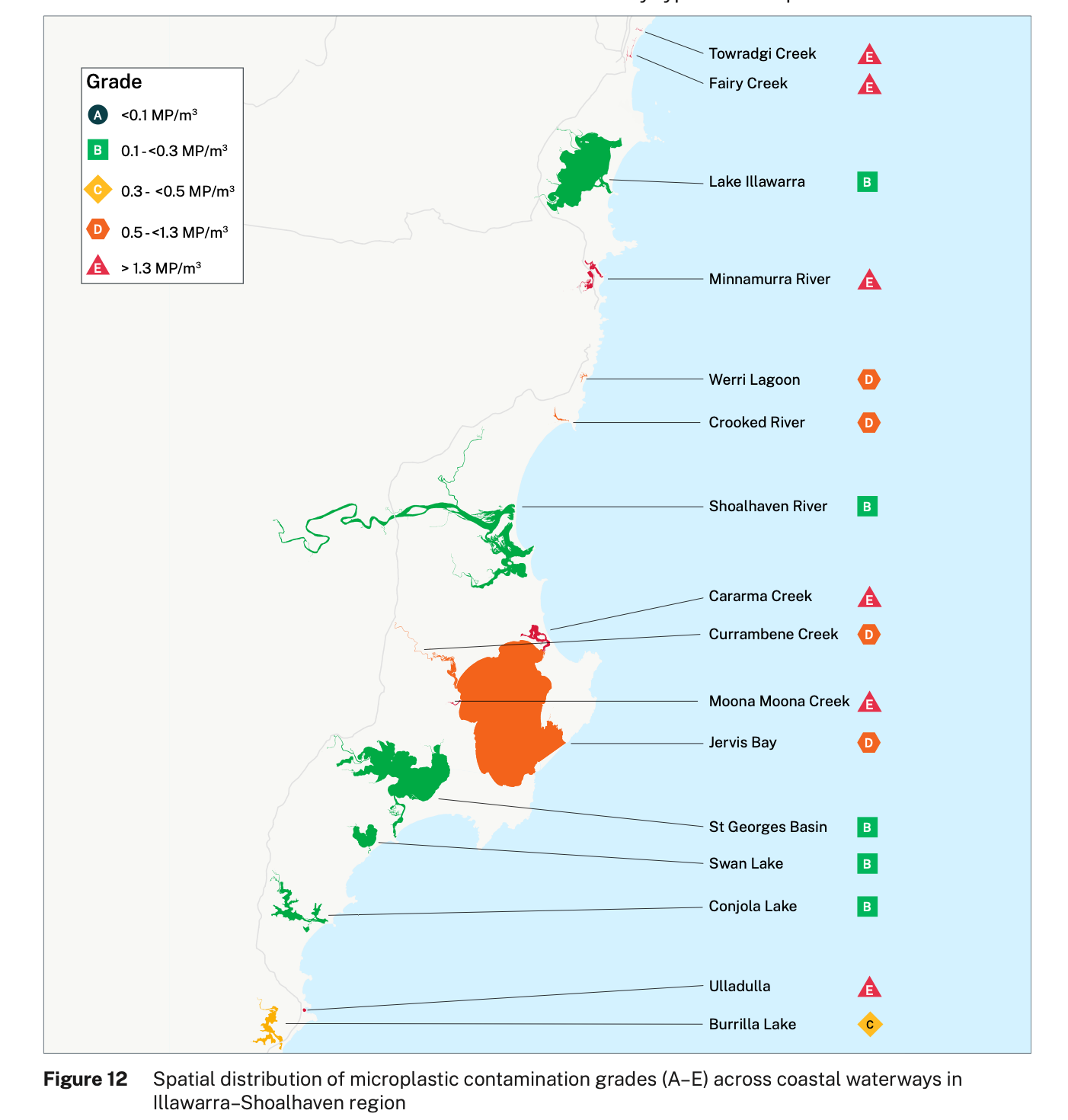
Former Shoalhaven City Council Environmental Services Manager, Dr Michael Roberts, knows the area well and cautioned that a higher concentration of microplastic contamination in Jervis Bay, compared to open bodies of water, reflects the way particles accumulate and circulate, especially in estuaries, rather than flush out to sea.
That geography might also affect the way spatfall impacts Jervis Bay.
University of Technology Marine Ecology Professor, David Booth, said mussel spawn spreads rapidly when currents and temperatures are right, causing major impacts on habitats.
Dr Booth is also a Research Associate at the Sydney Institute of Marine Science and co-author of the 2023 report, Creating a world class Marine Protected Area System, published by the Australian Marine Conservation Society.
“If anyone were to tell me that this is just a natural occurance I would think that's absolutely ridicuolous," Dr Booth said.
"Not only is there a huge spatfall but also the spat arrived exactly where the currents would bring them from the aquaculture farm and not yet elsewhere."
Dr Booth said he believed the mussel farm should be removed from Jervis Bay and jurisdiction of Jervis Bay Marine Park should be removed from DPI's Fisheries division "to where it belongs in the Department of Environment."
"I can't see another solution...unless there's some way to bring it (the farm) onshore."
"I'm a fan of the new technology of onshore aquaculture – it's almost lazy aquaculture just having it sitting in the marine environment with all the potential risks."
“Fisheries, who should be protecting the environment for the future, is clearly sponsoring something that's damaging the environment.
"It's just another prime example of where Fisheries is not fit for purpose in looking after marine parks."

"If anyone were to tell me this is natural, I'd say that's ridiculous." (LISTEN: 2 mins)
Sue Newson, a Jervis Bay dive tourism operator and experienced Reef Life Survey citizen scientist, questioned how the mussel farm's pivot to pet food supplements and shell grit qualified as a 'State Significant' development.
She said DPI's desire to manage Jervis Bay Marine Park as a resource asset would be better served by small tourism operators who have less impact and more financial sustainability.
Just a month ago, Newson photographed a dense layer of blue mussels covering shallow Jervis Bay reefs where she had never seen them in more than 20 years diving Jervis Bay.
Last year she photographed large mounds of mussels clumped underneath the farm, making a mockery of SCMs benthic surveys that reported no noticeable changes to the normal sandy bottom.
"I once measured one of these clumps, which was like a 15-metre long reef of mussels," Newson said
"It's changing that habitat. I think it's going to change the bay environment… and potentially harm a lot of areas that are meant to be protected."
When questioned about evidence of mussels clumping on the seafloor, Sam Gordon said that the farm could not clean up fallen mussels as that would constitute dredging, which was destructive to the environment and not allowed in the marine park.
Newson has documented changes to habitat and animal behaviour that she attributes to the mussel farm's influence.
"Diving under the mussel farm one day...there were hundreds of these lined bubble shells mating, laying eggs. They were all over the place. I've never ever seen that sort of concentration of this animal before, anywhere."
Previously, Newson was scouting for Port Jackon sharks at usual nursery locations but struggling to find any. As a last resort, she looked under the mussel farm.
"It was just the craziest thing, the moment we hit the bottom, there were the baby Port Jackson sharks. They're relocating from their normal sites – that worries me."
Newson believes pot-bellied seahorses, attracted to the vertical reef growth on the mussel farm infrastructure, are endangered during the mechanical harvesting process when ropes are cleaned of mussels and associated bycatch.
The farm's rich coverage of marine flora and fauna is what's known as an 'ecological trap' where human-made structures unintentionally become a preferred, but more dangerous habitat for animals than their natural environment.
"You'll sometimes get seahorses almost leaping off the anchor lines and swimming to another spot, where they hide in the growth," Newson said
"They're actually a protected species, not just in the marine park, but everywhere."
On larger mussel farm structures elsewhere, seahorses are well documented as processed bycatch during harvesting. But Scott Walter maintains that only shellfish meat and shells goes through SCM's drying mill.
"Other marine fauna aren’t attached in the same way (as mussels) and can move freely from the ropes during handling." Walter said
"Where interactions do occur, they’re managed under our marine fauna interaction plans, which experts, including seahorse specialists, developed with input."
DPI has not published reports of seahorse interactions at the Jervis Bay Mussel Farm. But anecdotal accounts from sources familar with SCM operations say that while it is possible to carefully separate seahorses from the ropes and return them to the water, inevitably some are injured or killed.
Sue Newson wants the areas of mussel blooms cleaned up and the mussel farm taken out of Jervis Bay before it affects the ecological integrity of the whole marine park in ways not yet predicted.
"People don't want to come here to see mussel farms. They want to come here to enjoy our marine life."
A PAPER PARK AND THE BOODEREE DIFFERENCE
Every year, people flock to Jervis Bay to experience the natural beauty and richness they believe is protected from degradation happening elsewhere.
But the law that lured them was quietly repealed a decade ago.
The NSW Marine Parks Act 1997 — the legislation that created Jervis Bay Marine Park with biodiversity conservation as its primary purpose — no longer exists. It was replaced in 2014 by the Marine Estate Management Act, which reframes the NSW marine parks as assets to be managed for competing economic, social and environmental uses, with conservation as one consideration among several rather than the goal that underpins everything else.
The dedicated Marine Parks Authority, whose mandate was to protect biodiversity and ecosystem function, was abolished. Day-to-day management of the state's marine parks passed to the Department of Primary Industries (DPI) — the same department that manages commercial fisheries and issues aquaculture leases.
NSW Department of Climate Change, Energy, the Environment and Water (DCCEEW) holds ' joint oversight' of marine protected areas. But when the two agencies disagree, DPI decides.
The consequences for Jervis Bay are not abstract, and the close partnership between government and industry is a textbook example of regulatory capture.
The same department (DPI) that approved a commercial mussel farm inside the park in 2014, also approved its expansion in March 2025 after overruling several formal objections from DCCEEW's own Ecosystems Director, who argued the farmed species was potentially invasive and that its spread into the park's waters may be unlawful.
DPI, which was simultaneously the applicant for the mussel lease, the author of the environmental impact assessment, and the authority responsible for the farm's regulatory compliance, approved the expansion anyway.
After local SCUBA divers documented unprecedented mussel colonies blanketing reefs, DPI committed to genetic testing to address the widespread spatfall concern. A year on, results are still unavailable.
Addressing injury or mortality of bycatch, including seahorses, the mussel farm established a Marine Fauna Interaction Management Plan and the Marine Fauna Entanglement Avoidance Protocol that includes oversight by a 'seahorse expert' who is also employed by DPI.
DPI staff, including the Principal Research Scientist based at the park headquarters in Huskisson, are not permitted to discuss the mussel farming in Jervis Bay Marine Park with media or the public.
The NSW Marine Estate Management strategy identifies fishing as a significant threat to marine biodiversity while simultaneously encouraging fishing operations in marine parks.
The current legislation declares the primary purpose of marine parks is to conserve biological diversity and maintain ecosystem integrity. However, critics argue that, in practice, the Management Plan erodes conservation by 'balancing' environmental, social, and economic incentives.
In stark contrast, Booderee National Park — owned by the Wreck Bay Aboriginal Community Council and jointly managed with Parks Australia — includes just 875 hectares of marine environment within Jervis Bay.
But the boundary between Booderee National Park and the NSW Jervis Bay Marine Park is not merely a line on a map. It defines two fundamentally different philosophies about what the ocean is for.
Booderee was declared a Commonwealth reserve under the Environment Protection and Biodiversity Conservation Act 1999 explicitly to conserve and protect terrestrial and marine wildlife and habitats.
Booderee has the power to expand and strengthen its marine sanctuaries and to benefit from their enforcement.
The new draft Booderee National Park Management Plan is open for public consultation until April 7.